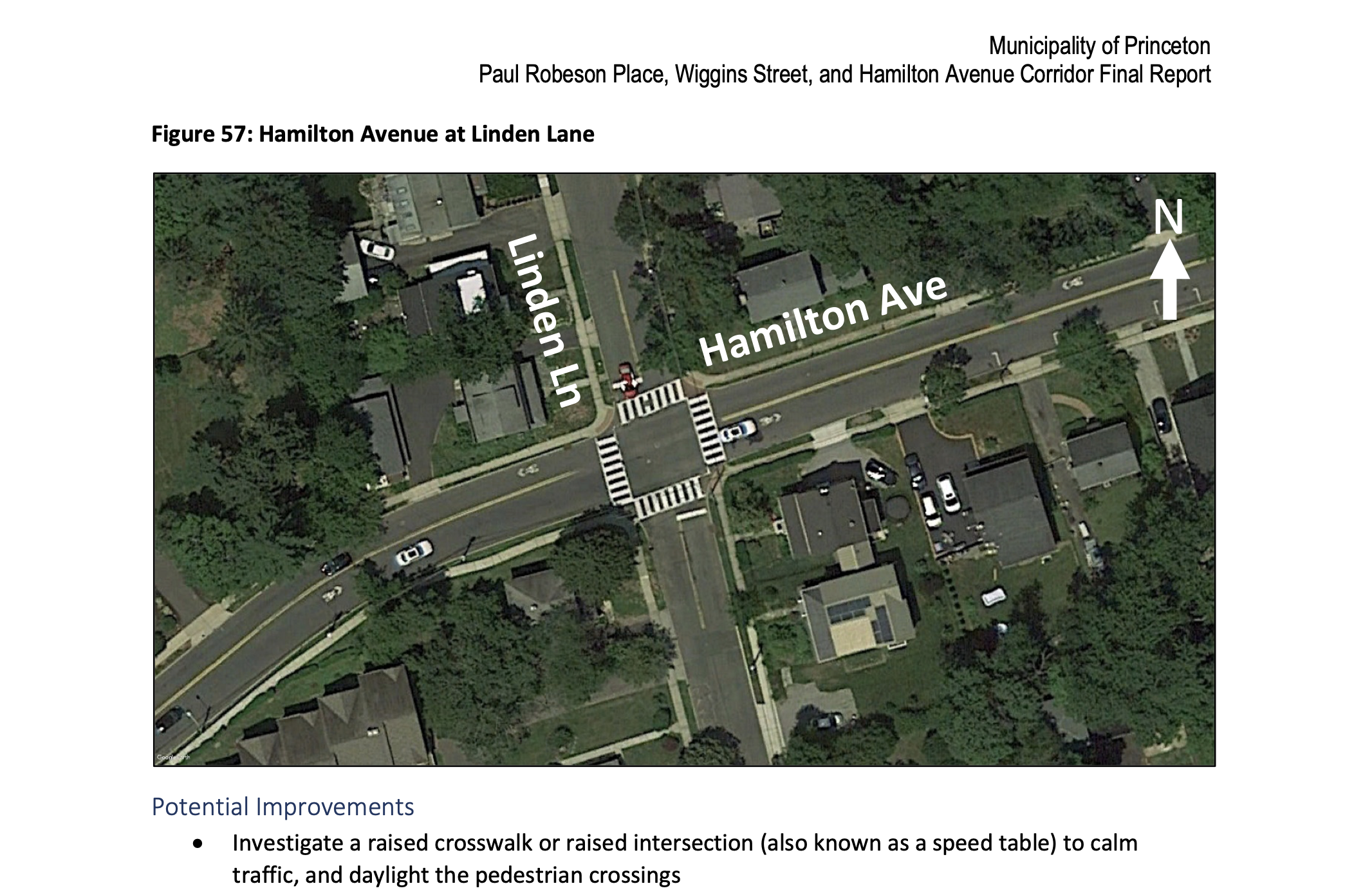
A large number of people attended the Princeton Council meeting last week to complain about the intersection of Hamilton Avenue and Linden Lane (map). As reported previously at ‘Princeton Patch’ (“Princeton Residents Press Council On Hamilton, Linden Traffic Safety“), there have been 20 crashes at this intersection since March 2023. Residents have started a petition calling for safety improvements. One resident pointed out that the failure to add safety improvements flew in the face of the town’s commitment to ‘Vision Zero’, which aims to eliminate serious crashes through safe road design.
Council member Mia Sacks said that if she were a member of the public, she would be “losing her mind” about the failure to add safety improvements. She pointed out that the town had conducted an engineering study for Hamilton Avenue years ago, but no action had been taken.
The final report of that engineering study is linked here. It was carried out by consultants from WSP starting in 2019. The final report was presented to Princeton Council on January 26, 2021. The study focused on the entire ‘Robeson-Wiggins-Hamilton’ corridor, stretching from Route 206 in the west to North Harrison Street in the east. (The road changes names several times in this stretch, starting with Paul Robeson Boulevard, then changing to Wiggins Street, and then changing to Hamilton Avenue.)
The report contains a clear recommendation for a ‘raised crosswalk’ at the intersection of Hamilton Ave and Linden Lane. Under “Potential Improvements” for this intersection, it says, “Investigate a raised crosswalk or raised intersection (also known as a speed table) to calm traffic, and daylight the pedestrian crossings.” However, this recommendation did not become a basis for action. In practice, almost none of the safety improvements recommended in the lengthy report were carried out.
Why did Council not enact the safety improvements from this extensive report? Council member Sacks suggested that it was because of indecision over what to do with bike lanes on Wiggins St and Hamilton Avenue. In 2018, a group of volunteers striped bike lanes on Wiggins St and Hamilton Avenue, with the town’s permission. Called the ‘Beta Bike Lane’, the goal was to test if bike lanes could work in this area. The town subsequently eliminated the bike lanes, with the idea that they might come back after the WSP corridor study was completed.
The WSP study did consider bicycle facilities on Wiggins St and Hamilton Avenue, providing four possible alternatives for the town to consider. But Council got caught up in a debate about what to do about street parking, which also involved an objector group called ‘Sensible Streets‘. In the end, Council did not take any substantive action about street parking, and also did not make any decision about bicycle facilities. No bicycle facilities were added to Wiggins Street or Hamilton Avenue. The street parking remained the same as it had always been. And the safety improvements recommended in the WSP report were forgotten.
The municipal engineering department moved on to a major project on Witherspoon Street, which was completed in three phases between 2019 and 2026. They are now focused on a major project on North Harrison Street, although the town is dialing back on safety improvements recommended by consultants along that corridor as well.
Related material:


