At the August 10 meeting of Princeton Council, the town’s elected officials got involved in a heated discussion over what had appeared to be a mundane resolution about a grant application to the New Jersey Department of Transportation. It became clear that the Mayor and various members of Council have quite different perspectives on what kinds of safety improvements should be funded by the town.
The grant application relates to proposed work on North Harrison Street. Since 2023, the municipal engineering department has been considering possible solutions to make traffic flow better – and more safely – along North and South Harrison Street. Safety improvements were planned to help advance the town’s “Vision Zero” policy, which aims to reduce traffic fatalities and serious injuries to zero, by “integrating safer street design into planning, capital projects, and maintenance”. In November 2024, Princeton Council received a detailed report from consultants, with a series of recommendations for improvements (Report: “North Harrison Street Improvements Set To Begin Between Nassau St and Franklin Ave, With Bicycle Improvements To Follow“).
The town successfully applied for grant money from the New Jersey Department of Transportation to help fund the work. But in recent months, discussions in municipal committees have concluded that the scope of work, which was estimated at $7 million, is too great. In particular, Councilman Brian McDonald was strongly in favor of cuts. He said that the proposed work should not go ahead without the town having a more complete list of priorities for capital projects, and also expressed doubt about financing for any projects that are part-funded by NJDOT.
As a consequence, the town will cancel or indefinitely postpone the following improvements, which had previously been planned:
- Intersection improvements at North Harrison Street and Valley Road (at the entrance to the Princeton Shopping Center);
- Intersection improvements at North Harrison Street and Bunn Drive (near Princeton Charter School);
- A sidewalk on the west side of North Harrison Street, between Franklin Avenue and Valley Road (opposite the Princeton Shopping Center);
- Improved, grade-separated bike lanes in the area around Princeton Shopping Center, to replace and improve on the temporary ‘pilot’ implementation that is in place today.
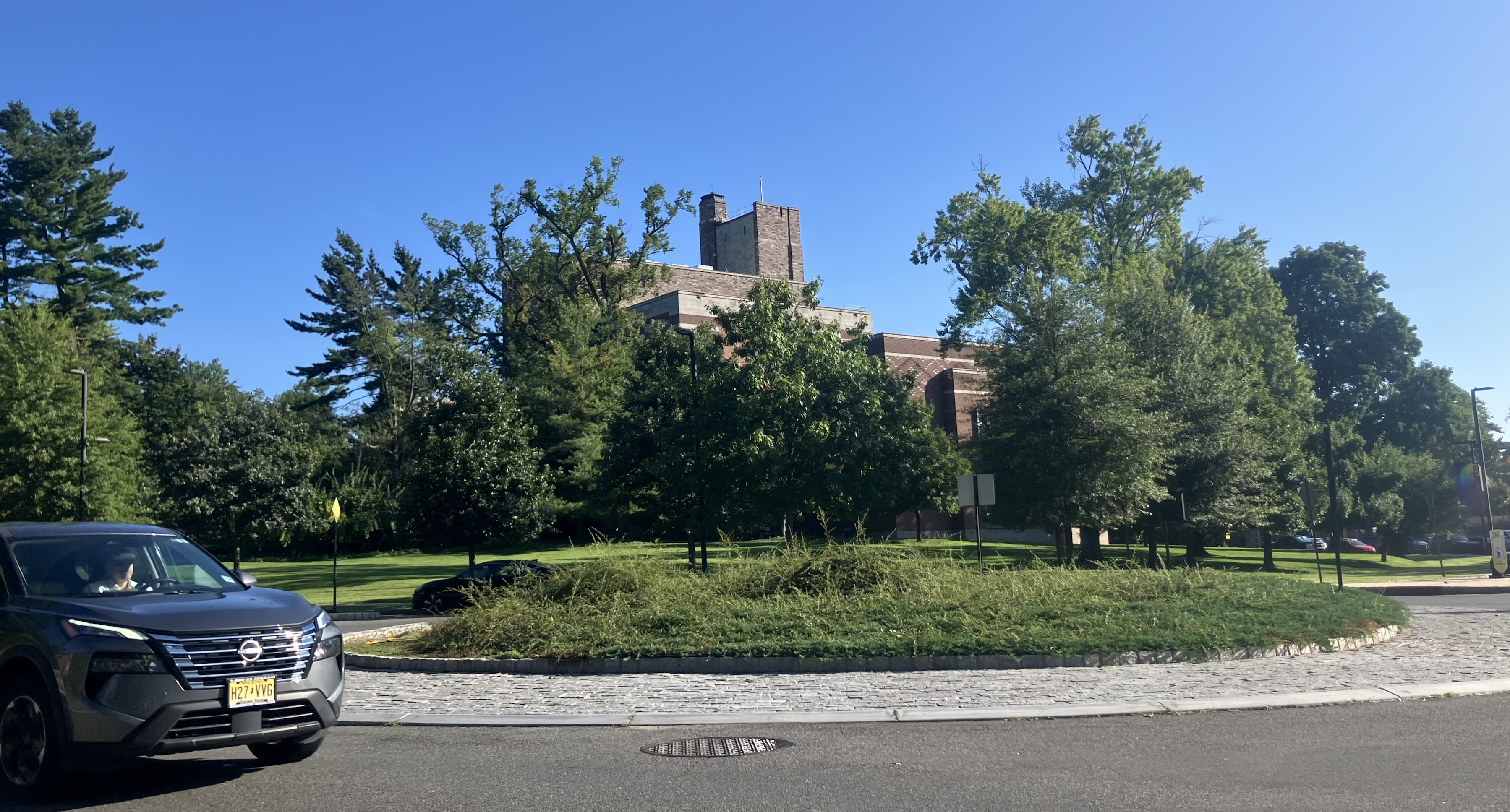
With these cuts to the North Harrison Street project, grant money would be focused on one remaining intersection, at North Harrison Street and Terhune Road. This intersection is currently controlled by an out-of-date traffic signal, which often does not appropriately sense vehicles. The consultants recommended a roundabout at this intersection, similar to those in the Western Section, at University Place and Alexander Street (see image above), or at Rosedale Road and General Johnson Drive. Roundabouts enable better traffic flow, because drivers do not have to wait at red lights. They also have a lower rate of serious injuries in crashes. The roundabout would enhance safety and smooth traffic to the Terhune Road Transit Village, where hundreds of new apartments have been built in recent years, to help meet the town’s state-mandated affordable housing obligations.
Mayor Mark Freda immediately objected to the resolution. He wanted to know why the engineer’s memo said that the new buffered bike lanes on North Harrison Street were “functioning”. The mayor also insisted the bike lanes were only supposed to be implemented as a ‘pilot project’ for one year. When was the review of their success going to be carried out? And should that not happen before discussion of any other improvements on North Harrison Street?
It quickly became clear that the staff and various members of Council had different impressions of what ‘pilot project’ meant. The municipal engineer, Deanna Stockton, said that the ‘pilot’ was intended to last until the time when the current, interim layout could be replaced with a permanent configuration. The permanent configuration would improve on the existing layout, and draw from lessons learned about the effectiveness of the bike lanes. Ms Stockton said that there would be further review of the bike lanes this fall, but asked that Council consider carefully their benchmarks for ‘success’.
Since the new bike lanes were installed, there have been no pedestrian or bicyclist injuries in the project zone, although there is a feeling among staff and members of Council that the current layout is not as good as it could be. With the interim configuration, the bike lanes are so wide that car drivers have regularly been driving down them. An improved, permanent layout could help resolve that issue, but that proposal has now been canceled for the foreseeable future. The Mayor seemed to think that the bike lanes should go away altogether, but Council member David Cohen expressed surprise at that, “I haven’t heard anything that going back to four lanes of traffic would make things safer…all the complaints I hear are about the way the bike lanes are installed.”
Council member Mia Sacks also questioned whether the town could seriously say it was committed to encouraging alternative modes of transportation if it was ripping out bike lanes in an area where the town has concentrated development in recent years: “If we’re not going to put bike lanes on the widest most central street in town, a major artery, then we’re making it clear that we’re not for bike infrastructure…So then let’s just be honest and say we have given up on doing bike infrastructure and and not raise the hopes of the community.”
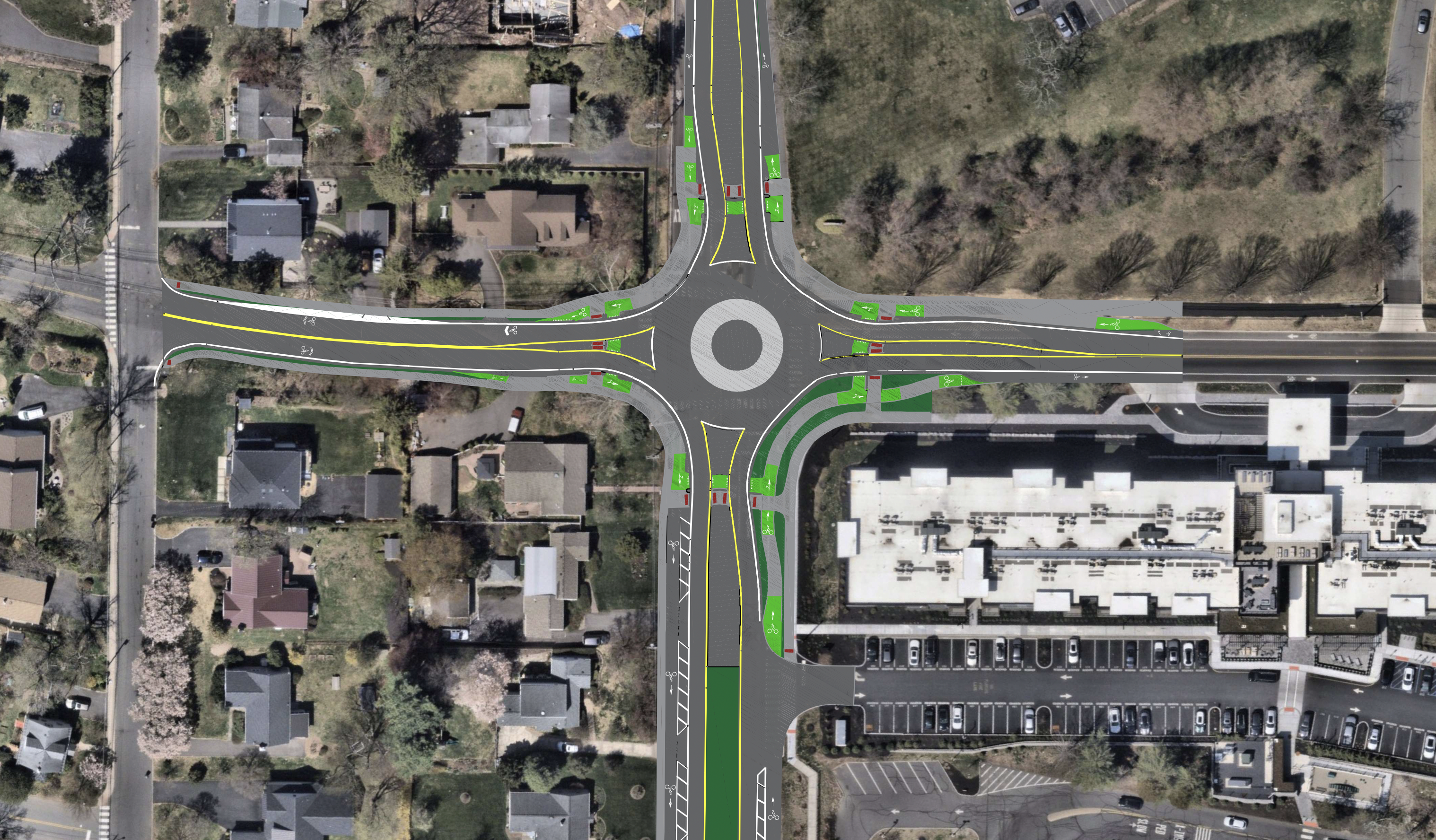
Mayor Mark Freda also seemed very unhappy about the proposal for a roundabout at North Harrison Street and Terhune Road. Although this is the only remaining intersection that would see improvements in the current phase of work, the Mayor demanded to know if some other implementation could be done that would involve spending even less money. He suggested that “simple things” like new traffic signals could be installed instead.
Mia Sacks pointed out that the question about having a roundabout or new traffic signals had been discussed extensively in municipal committees, and while she was ‘agnostic’ about what to do, she had found out that new traffic signals might actually be even more expensive than the proposed roundabout. Council member David Cohen pointed out that a roundabout had the potential to give a much more positive ‘driver experience’, because of improved traffic flow. Cohen said that other roundabouts that had been installed in and around Princeton had been successful. Mayor Freda appeared unconvinced. He said that the roundabout could be “pretty costly”. “In the back of my mind it’s just, here’s more money out the door,” he said, “We only have so much money!”
Ultimately, Council voted unanimously to move ahead with the reduced scope of work on North Harrison Street, dedicating the state grant money exclusively for the intersection at Terhune Road. The engineers would revise the considerations for that intersection, to make clear that the town is equally open to a roundabout or new traffic signals. The town must issue an award to a contractor to start the proposed work “by late 2027”, with construction work potentially starting in 2028.
Related materials:
- Princeton Municipal Engineering Department Information Page about Witherspoon Street Corridor project.
- Engineer’s memo explaining Resolution R-26-236, which refines use of state grant money for intersection of North Harrison Street and Terhune Road.
- Text of Resolution R-26-236, “Resolution of the Mayor and Council of Princeton Authorizing the Submittal of a Scope Modification Request to the New Jersey Department of Transportation for the FY 2026 Municipal Aid Grant on North Harrison Street”
- Video of Princeton Council Meeting from August 10, 2026. (Discussion of North Harrison Street begins at 1:12:04 and runs through 1:49:01.)


I drive on North Harrison St 2-3 times per week and I am yet to see one bicycle in the new dedicated bike lanes.
I often bike thru the Terhune/North Harrison intersection. The traffic light somewhat reassures me that the cars are likely to stop. With a roundabout one never knows what the cars will do. I was hit by a car while on my bike in one of the western section roundabouts. I was to the left of the car that was curving right: “I didn’t see you”.
Hi–It’s always nice to learn Princeton news from Princeton Walkable before official general news sites release the information. I hope soon we’ll learn how any of the contemplated North Harrison/Terhune intersection driving/biking changes interface with the municipality’s plans to build a pedestrian south on Terhune. One request for future articles that mention our town’s affordable housing initiatives… please, please, please do not describe the recent and future apartment complexes as being constructed in order to provide affordable housing. It is the most expensive and least efficient method of doing so, particularly since the 20% affordable rental units requirement expires for these buildings after 30 years. Additionally, by maintaining a 5 to 1 ratio of wealthy over moderate income residents, it does nothing towards making our town more equitable over all.
Thanks, Betty Wolfe
Its a shame that we can’t even have basic safety improvements and quality of life improvements. Who would have thought that the Mayor is so against safety improvements. Seems like Princeton picked the wrong person to lead the town and make things safer for our community.
The bike lanes on North Harrison are the ugliest, least effective bike lanes I have ever seen. Sure, they are a “pilot program” but a pilot requires monitoring to determine the effectiveness of the lanes, both from a utilization as well as a safety perspective. The lanes are obviously underutilized and the safety benefits to cyclists are debatable in the current configuration. Simply sticking some sticks randomly in the pavement and painting a line does not make for a safe bike lane, as evidenced by the retrofitting of plastic Jersey Barrier at each affected intersection on North Harrison. BTW, the next useful question here is “where do the cyclists go after the new bike lanes end?” Why, of course, they get dropped back onto the main thoroughfare, so the “safety” benefits (if any) exist just in front of the Shopping Center.
It is good to see Mayor Freda standing up for the taxpayers of Princeton and speaking out against vanity projects such as these useless bike lanes.
BTW, for those commenters who will accuse me of “hating bicycles” or some such nonsense, nothing could be further from the truth. We need effective, well designed bike lanes, consistent enforcement of laws governing bicycle use and no new roundabouts. As mentioned by another commenter, the roundabout may be motor vehicle friendly, but it turns bicycles into targets for motorists who “just didn’t see” a cyclist. Roundabouts are also much less pedestrian-friendly than typical signaled intersections. I’m sure these lanes make some Town Council members feel good, but they are indeed a waste of money and Mayor Freda is correct to want them removed.
Mark Freda: Slight correction to how this was reported. My comments reflected my opinion that these bike lanes do not work well as designed. Nor are they used much. I have spent a lot of time getting barriers in place to block cars from entering these bike lanes. These were originally explained to the governing body as a project that would b reviewed a year installation, hence the “pilot project” description. In my opinion they cannot stay as currently designed, they are dangerous to bike riders as configured. And confusing to vehicle drivers.
My comments on the intersection of Terhune and Harrison reflected my opinion that a study of that intersection should not force one conclusion on whoever does the study of the intersection, in this case a roundabout. The materials presented at the meeting seemed to indicate the roundabout was already decided on. Data and cost should be weighed to make a final decision on this matter.
Pingback: North Harrison Street Safety Improvements Questioned by Council - Walk Bike Princeton