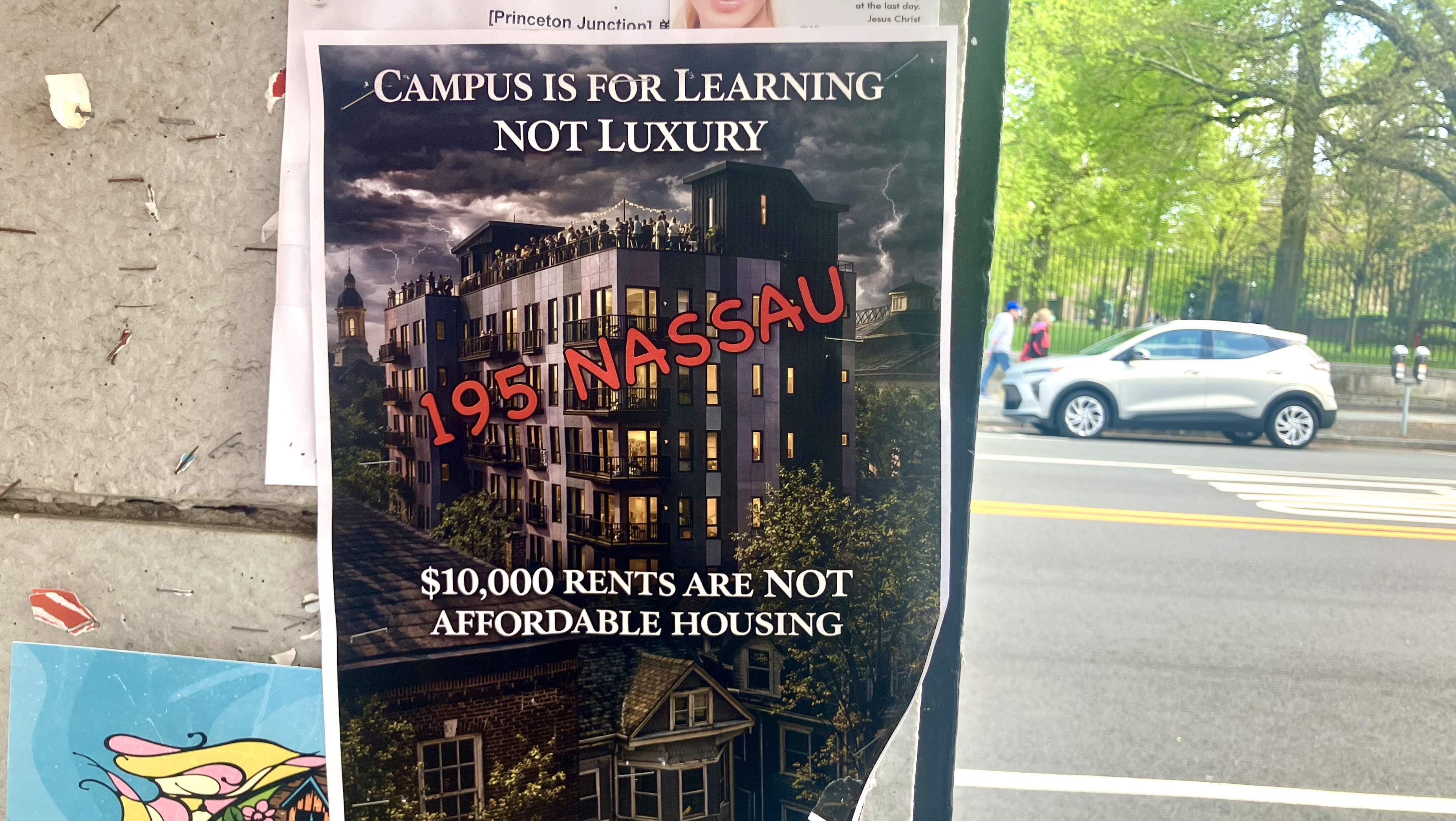
Posters have appeared in downtown Princeton expressing concern about rental rates at ‘195 Nassau‘, a new inclusionary apartment community at Nassau Street and Charlton Street (map). The posters, which were placed at the community information kiosk at the top of Witherspoon Street, complain that “$10,000 rents are NOT affordable housing”.
195 Nassau is an inclusionary development with a total of 45 units, of which 20% must be made available as ‘affordable units’ meeting state standards for affordability to qualifying. It was permitted by the town of Princeton’s 2019 fair housing settlement, which created a new “AHO-1” zoning overlay to incentivize construction of mixed-income housing developments.
Last month, ‘Tap Into Princeton’ reported that a lottery had begun to fill the nine affordable units in the 195 Nassau development. Those affordable units will rent starting at $589 per month for a very-low-income two-bedroom unit, up to $1,670 per month for a moderate-income 3-bedroom unit. Princeton Community Housing is handling the applications for the affordable units. The deadline to apply for the initial draw is May 8, 2026. It is likely that demand for the units will greatly exceed the nine affordable units that are available.
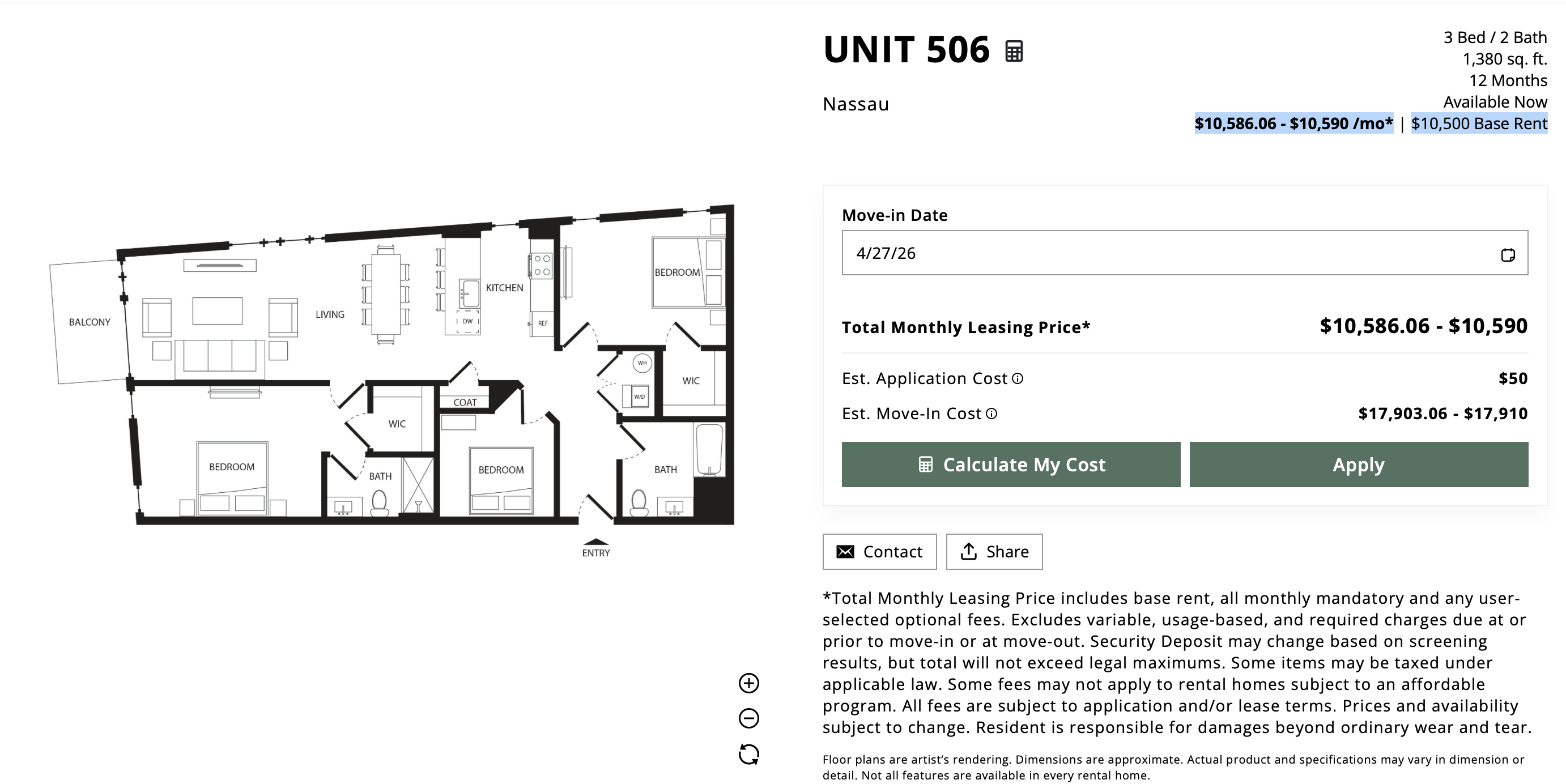
More recently, rental rates for the remaining 38 units in the building have been published at the 195 Nassau website. These market-rate units start at $4,700 per month for a 1-bedroom unit, rising to $10,500 per month for 3-bedroom, 2- bathroom apartments on the top floor. That top figure of $10,500 per month matches the rate mentioned on the posters on the information kiosk.
It’s not clear who placed the posters complaining about the $10,000 rents at 195 Nassau. The posters have no website, email address or other identifying feature. Instead, there is an AI-generated image of the apartment building, with a massive party on the roof deck, against a thunderous background. A cupola resembling that of Nassau Hall appears behind the building, even though the real Nassau Hall is at least 1/4 of a mile to the west of the site.
Anonymous campaigns objecting to housing are not a new thing in Princeton. In 2024, the anonymous ‘Save our Setbacks’ group campaigned against a plan for two single-family homes on Jefferson Road (Report: New Princeton Objector Group Takes Aim at Proposed Jefferson Road Subdivision). That subdivision plan was ultimately blocked when the Planning Board, fearing litigation, refused to extend its approval of the application.
The group who made the posters about 195 Nassau may be affiliated with Princeton University, because the poster includes the words “CAMPUS IS FOR LEARNING NOT LUXURY”. According to state tax records, 195 Nassau Street is not part of Princeton University campus, although the site has been included in Princeton University’s recent e-bike ban. The new building is not specifically targeted at Princeton University students either. Princeton University guarantees on-campus housing for all its undergraduates for all four years.
It is correct, however, that $10,000 rents are not affordable housing. As noted above, the affordable units in the 195 Nassau development rent for $589 per month – $1,670 per month. $10,000 per month is the price for the most expensive market-rate units. It is certainly very high by the standards of Princeton apartments, but in an inclusionary apartment community, the rents of market-rate units subsidize the affordable units. This allows affordable housing to be built without taxpayer subsidy, but at the cost of pushing up rents in the market-rate units. Without the construction of 80/20 mixed-income buildings like 195 Nassau, it is likely that there would be no affordable housing at all. The site for the building was a surface parking lot for decades prior to construction.
Related links:
- 195 Nassau Street apartment community website.
- Affordable housing flyer for 195 Nassau, advertising affordable rental rates and instructions for how to join the lottery.
- Princeton NJ 2018 Third Round Affordable Housing Settlement, which includes the ‘AHO-1’ inclusionary zoning overlay.


