New Jersey Commuters Missing out on Signs of Spring

shoots

For those of us who are able to walk or bike to work, this time of year offers a great deal of delight! Everywhere, nature gives us glimpses of spring, as shoots push up from the ground with the promise of beautiful flowers to come. Buds are developing on the trees, and birds are particularly full of song as they pair off for the season.

Sadly, new research indicates that many New Jersey commuters are missing out on these signs of spring. Data from the US Census Bureau revealed today that people in New Jersey have on average the second-longest commute in the nation. 1 in 7 NJ commuters travel more than an hour to get to work. This takes a massive toll on the individual and their families. It’s not much fun to have to sit in traffic or squashed on a commuter train, neither of which offer much of a view of the signs of spring around us.  As the linked article from the Star-Ledger notes, scientific tests performed on ‘mega-commuters’ revealed:

 “they had a harder time staying on task and had elevated levels of the stress hormone cortisol”

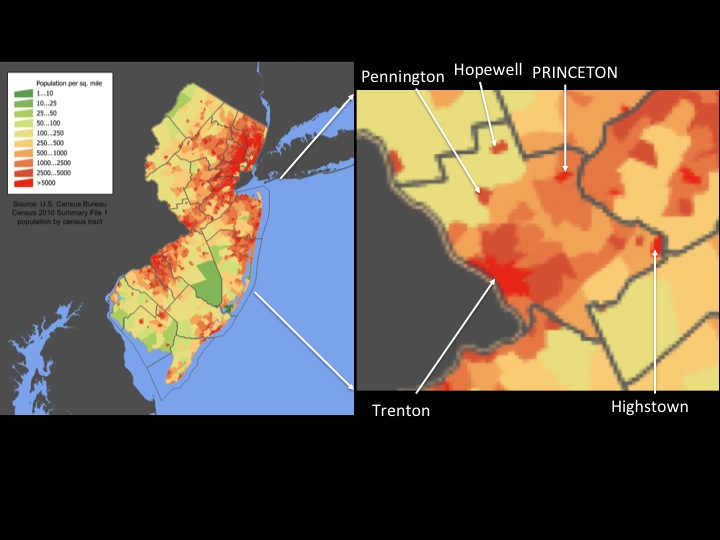
Why then do we choose to live so far away from our places of work? In many cases, people are making an active choice, including no doubt many of the 6,346 individuals who commute daily from Mercer County to New York. Living in the Princeton area offers the possibility of having a larger home with a yard, and the advantages of great schools. But may other people must make longer commutes than they desire because they can’t find a home near their place of work. Zoning restrictions that favor low-density housing requires spread-out development patterns that require people to get in cars and drive to get to work.

At Walkable Princeton we believe that allowing people to live close to their place of work  and favoring walking and biking will raise everybody’s quality of life. We can reduce commute time, traffic and oil use by permitting more flexible zoning that enables people to live near where jobs are in central Princeton. It is crazy to require longer commutes and traffic when we could accommodate many more people in Princeton with a moderate increase in housing units. Increased density on infill sites around the Princeton downtown would greatly increase the percentage of people able to walk to work, and help reduce the toll of long commutes on individuals and families. Walkability is best, because a longer trip to work isn’t so bad if you are on foot, getting valuable exercise and being able to appreciate the nature around you!

* As a final point, and relating to yesterday’s post (Too Many Cars Around Princeton) about the increasing number of cars on Princeton area roads, it’s worth pointing out that the Census data also showed that more commuters pass daily from New Jersey into Pennsylvania than travel the other way. You often hear that roads in Mercer County are clogged with Pennsylvania commuters who live in Bucks County to take advantage of lower taxes and then drive into New Jersey. The figures show that we are sending just as many people the opposite direction into Pennsylvania.

Posted in Biking, Sustainability, Traffic, Transit, Walking | Leave a comment

Too Many Cars Around Princeton

northbrunswickjpg-rt1_large

Princeton Mayor Liz Lempert and several members of the Princeton Council expressed serious reservations last week about a new plan from the New Jersey Department of Transportation (NJDOT) to make alterations to Route 1 just south of Princeton. The new plan would close jughandles connecting Route 1 to Alexander Road South and Harrison Street, and make a new configuration including adding extra lanes and installing new jughandles. The estimated cost is $40 million. NJDOT are seeking urgent input on this plan, after their previous experiment at altering the road layout on Route 1 last fall ended with widespread local protest.

Traffic along Route 1 near Princeton is undeniably terrible. But is it possible to make traffic flow better by adding new lanes and tweaking junctions? It has been recognized for some time that following road widening projects, improved traffic flow can be short-lived, as new cars enter the system to fill up any available space on roads. This ‘induced demand’ results in a never-ending cycle of road building, followed by increased cars, leading to more road building. Meanwhile, fields and farmland are paved over to create new traffic lanes and jug-handles. Roads usually stay built after they are constructed, (even when they are full of pot-holes!) so paved fields are lost forever, reducing green spaces and increasing impervious surfaces that put pressure on watersheds.

How can we reduce traffic around Princeton without continually widening roads? We could force people out of their cars, by charging tolls or taxes for road use. But perhaps a better long-term solution is to remove barriers to people living near their places of work and stores, so that fewer journeys require the use of a car. This means allowing more people to live near where stores and jobs are. In Princeton this means allowing more homes near the downtown area. There is already a lack of housing in downtown Princeton, which is forcing people to live in surrounding areas like Montgomery township, Plainsboro and Lawrence. Traffic from people commuting into Princeton to work and play is a significant cause of regional congestion. If more people could live closer to town, we could take many cars off the road.

There is not a huge amount of undeveloped land around Princeton for potential car-lite local residents to live. Unfortunately, the few remaining acres are often subject to highly restrictive zoning regulations that make it hard to add many new homes there. Walkable Princeton has a goal of promoting walkable, downtown living. This will allow people to ‘live locally’ and reduce oil use and traffic. We believe that the alternative-ever increasing traffic and sprawl-is both undesirable and unsustainable.

Posted in Local, Princeton, Sustainability, Traffic, Transit | 3 Comments

New Sidewalks on Ewing St in Princeton

New sidewalk construction at Ewing Street, Princeton.

New sidewalk construction at Ewing Street, Princeton.

Although Princeton is already a very walkable area, there are significant sections of the town where there are no sidewalks. For one section of Ewing Street in Princeton North, that is now changing (see photos above and below).

Continue reading

Posted in Local, Princeton, Walking | Leave a comment

Walkable Neighborhoods Linked to Social Wellbeing

DCIM100MEDIA

Many of us who are lucky enough to live in downtown Princeton recognize the benefits of living in a close-knit community where we frequently see our neighbors and interact spontaneously with friends while shopping or walking around. A University of New Hampshire Study, funded in part by the EPA, went further and actually looked to see to what extent walkability correlated with measures of social wellbeing among 700 residents of Portsmouth NH (pictured below) and Manchester NH.

The results were striking:

“Those living in more walkable neighborhoods trusted their neighbors more; participated in community projects, clubs and volunteering more; and described television as their major form of entertainment less than survey participants living in less walkable neighborhoods.”

These findings fit with something that many of us intuitively see as true: there is a great sense of neighborhood when people are able to walk around to carry out their daily business. It brings people into the public space together and allows random encounters and conversations. Many people in car-dependent neighborhoods have a good sense of community too, but it’s hard to have the same interaction when you’re zooming along in a car.

Click the link below to read the full story:

http://www.unh.edu/news/cj_nr/2010/dec/bp13capital.cfm

Posted in Walking, Zoning | Leave a comment

New Jersey Needs More Walkable Homes

bayfront-nj-development--300x224

This link is from NJ Future, a nonprofit organization that promotes responsible land use.

The author points out how demographic changes and a recognition that car-dependent lifestyles bring traffic and sprawl has resulted in a huge pent-up demand for walkable housing. However, as the author points out:

“Too many walkable urban projects are derailed by lack of zoning, lengthy approval processes and local resident opposition. The majority of those who oppose such projects are often the very residents who will benefit the most from increased walkable urbanism, and at no cost to themselves.

This is so true! In many cases, including here in Princeton, people have used the planning process to prevent smart growth developments that offer enormous benefit to the town. Walkable Princeton will continue to reach out to the Princeton community to inform about how development in the downtown core offers true environmental and economic sustainability.

Read more at:

http://www.smartgrowthamerica.org/2012/03/06/new-jersey-isnt-capitalizing-on-demand-for-walkable-places/

Posted in Density, Real estate, Zoning | Leave a comment

Announcing Walkable Princeton!

Walkable Princeton, founded in February 2013, aims to focus development in newly consolidated Princeton, NJ on walkable forms to gain the benefits of smart growth.

In this letter, David Keddie announced the motivation for the founding of Walkable Princeton:

http://planetprinceton.com/2013/02/11/letters-announcing-walkable-princeton/

Posted in Events, Local, Princeton | Leave a comment