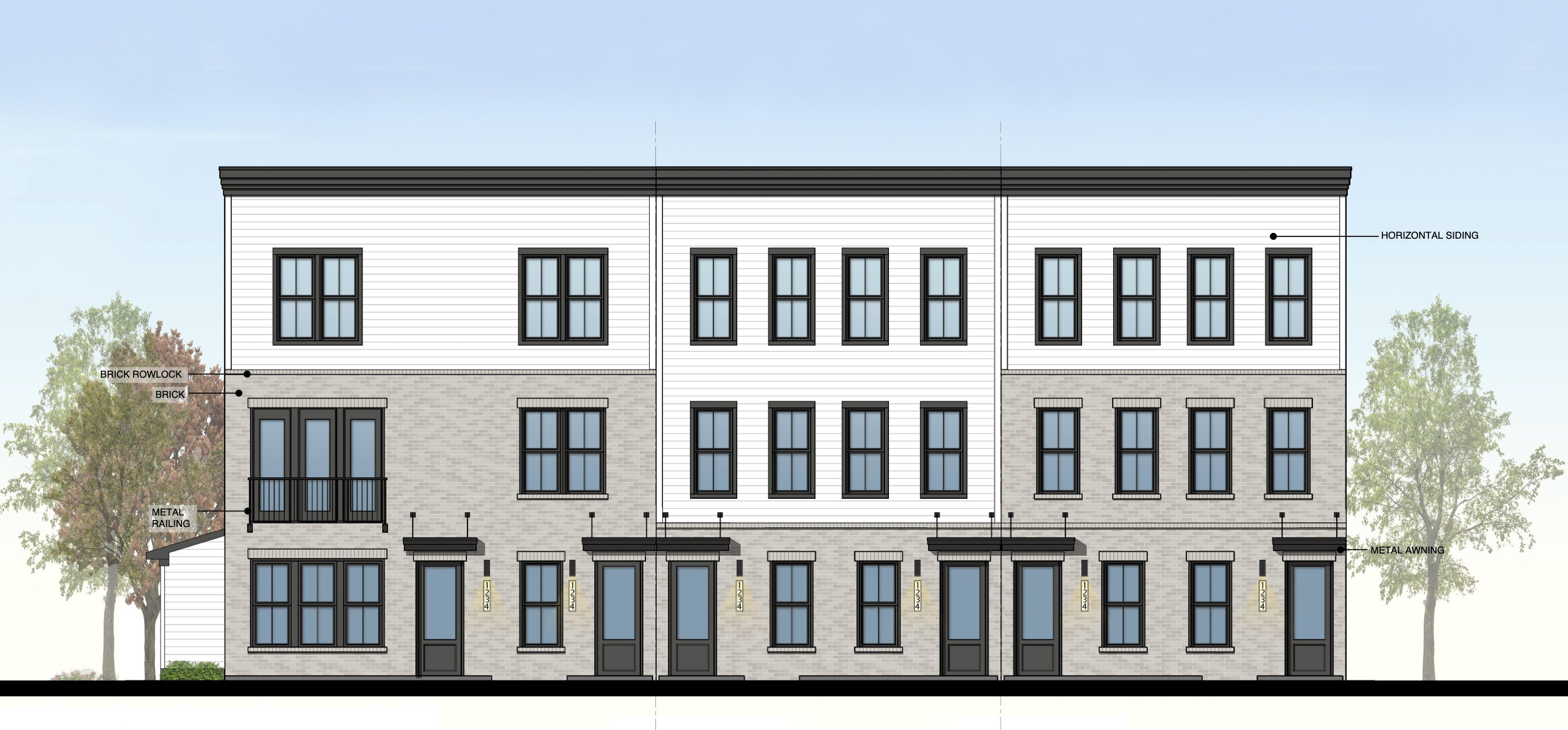
An application by Toll Brothers to build 85 new homes at 29 Thanet Circle (map) was approved by the Princeton Planning Board on Thursday, June 4. The new homes will be built as ‘stacked townhomes’, to be sold to their future owners (as opposed to being rented). 20% of the units will be designated ‘affordable’ units, with the sale price significantly reduced for households of limited incomes. This development forms part of the town of Princeton’s ‘Fourth Round’ affordable housing plan, which is required to meet state fair housing law (Report: Town of Princeton Embraces ‘Smart Growth’ With Proposed Sites For New Affordable Housing“).
The new townhouses will be built in ten buildings, on the site of an existing disused office building. The application was compliant with the town’s AH-14 affordable housing overlay for this area, but the Planning Board nevertheless took three meeting to examine all the application materials. At the first hearing, on May 7, Board members discussed stormwater management, plans for traffic circulation and parking, and landscaping. The site contains a stream, which is a tributary to Harry’s Brook, which runs through this neighborhood. Planning Board Chair Louise Wilson expressed concern about the number of yellow irises and invasive reeds growing around the stream.
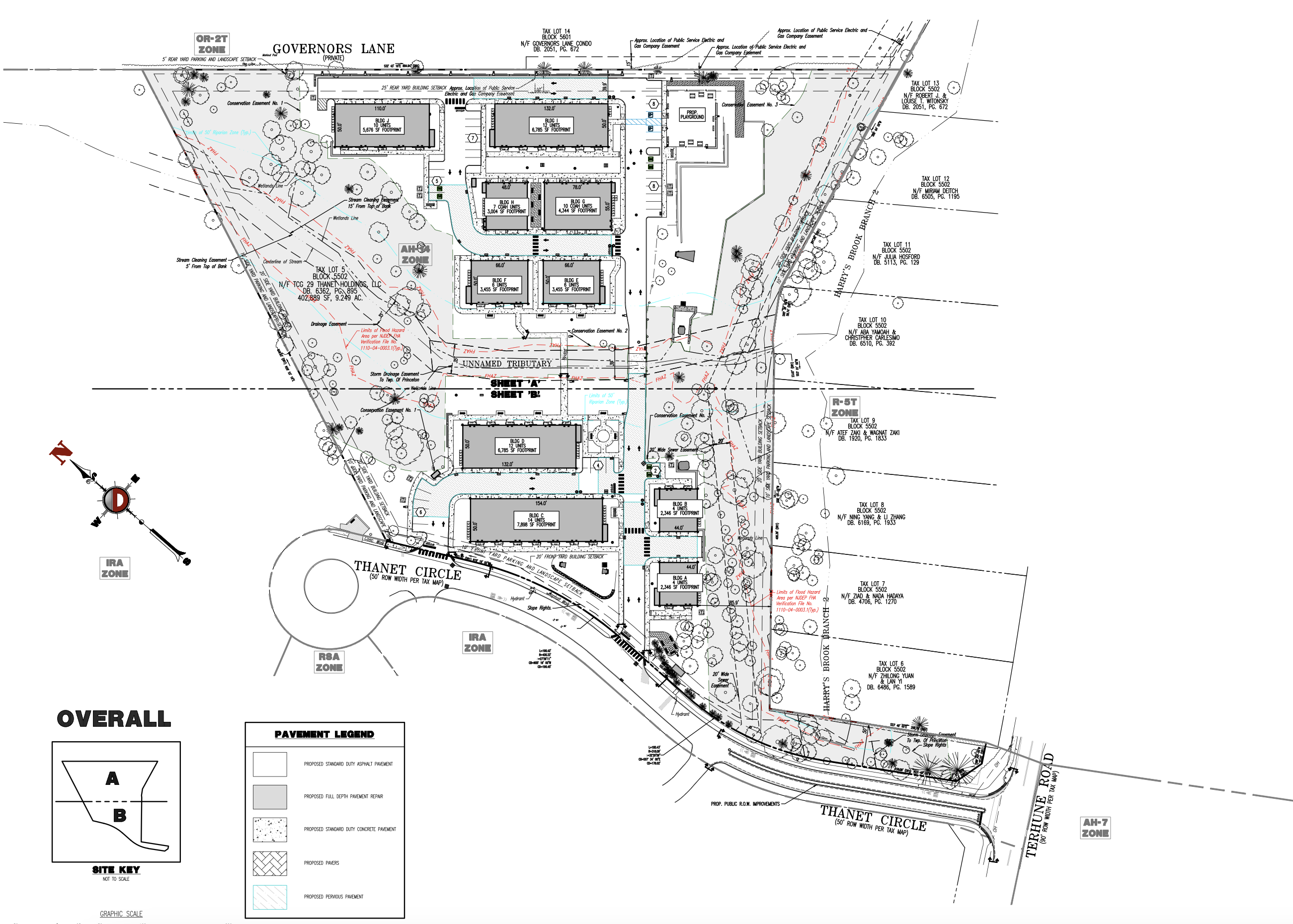
At the second hearing, on May 28, the question of clustering of affordable units was raised as a potential issue by several members of the Planning Board. The affordable townhouses would all be contained in two of the ten buildings. Those two buildings would only contain affordable units. The other eight buildings would contain homes that would be sold at the regular market rate. “It makes me uncomfortable”, said Board member Alvin McGowan, who also noted that the affordable units would be smaller in size than the other townhouses.
In response, the applicant’s attorney, Creigh Rahenkamp, said that it is permissible to cluster affordable units in developments containing units that would be sold instead of rented, as long as the affordable units are not in an inferior location. In this case, he pointed out that the location of the affordable units was very good, at a central location in the development, near a new playground. Planning Board member David Cohen agreed that the location of the affordable units was good. The affordable units also comply with standards specified by state law, the ‘Uniform Housing Affordability Controls’.
During public comment, concerns about the development were raised by residents of the nearby “Governors Lane” townhouse community. The Housing Association there had drafted a letter requesting details and independent technical analysis of stormwater studies, fire flow tests on hydrants, sewer capacity, and traffic circulation. There was anxiety about noise and dust control during demolition and construction, and the possible presence of asbestos. Some residents wanted enhanced barriers between the new development and Governors Lane, which might include plantings, walls, fences, or possible walls with fences on top of them.
Many of the potential issues with stormwater and traffic had already been considered, and the developer was amenable to talking to the Governors Lane residents and making sure that they had a point of contact during construction. Although the Governors Lane residents seemed anxious about the proposed development, they did not seem committed to the kind of legal war like that launched by neighbors against proposed apartments on Stockton Street (Report: “‘Washington Post’ Commenters Not Impressed With Princeton University Professor’s Opposition to Proposed Inclusionary Housing Development“).
In a third meeting to consider the proposed development, the Planning Board reviewed a list of 35 conditions for approval of the plan. These conditions included tweaks to the design of several buildings, clarifications about stormwater management and parking, and specifications about the demolition and construction process. There was substantial consideration about what chemicals the future homeowners association could use to manage weeds on the lawns. Restrictions will be added to homeowners documents stating that they are not allowed to use garages for storage, but only for parking cars. Ultimately, with these conditions agreed, the Board approved the development application unanimously.
Related links: (via princetonnj.gov)
- Developer’s application and narrative
- Site plan for 29 Thanet Circle redevelopment
- Architectural drawings of the proposed townhouses
- Draft list of 35 conditions considered for development approval
- Video of May 7 Planning Board meeting, first hearing for the 29 Thanet application
- Video of May 28 Planning Board meeting, continuation of the 29 Thanet application
- Video of June 4 Planning Board meeting, conclusion of the 29 Thanet application.


