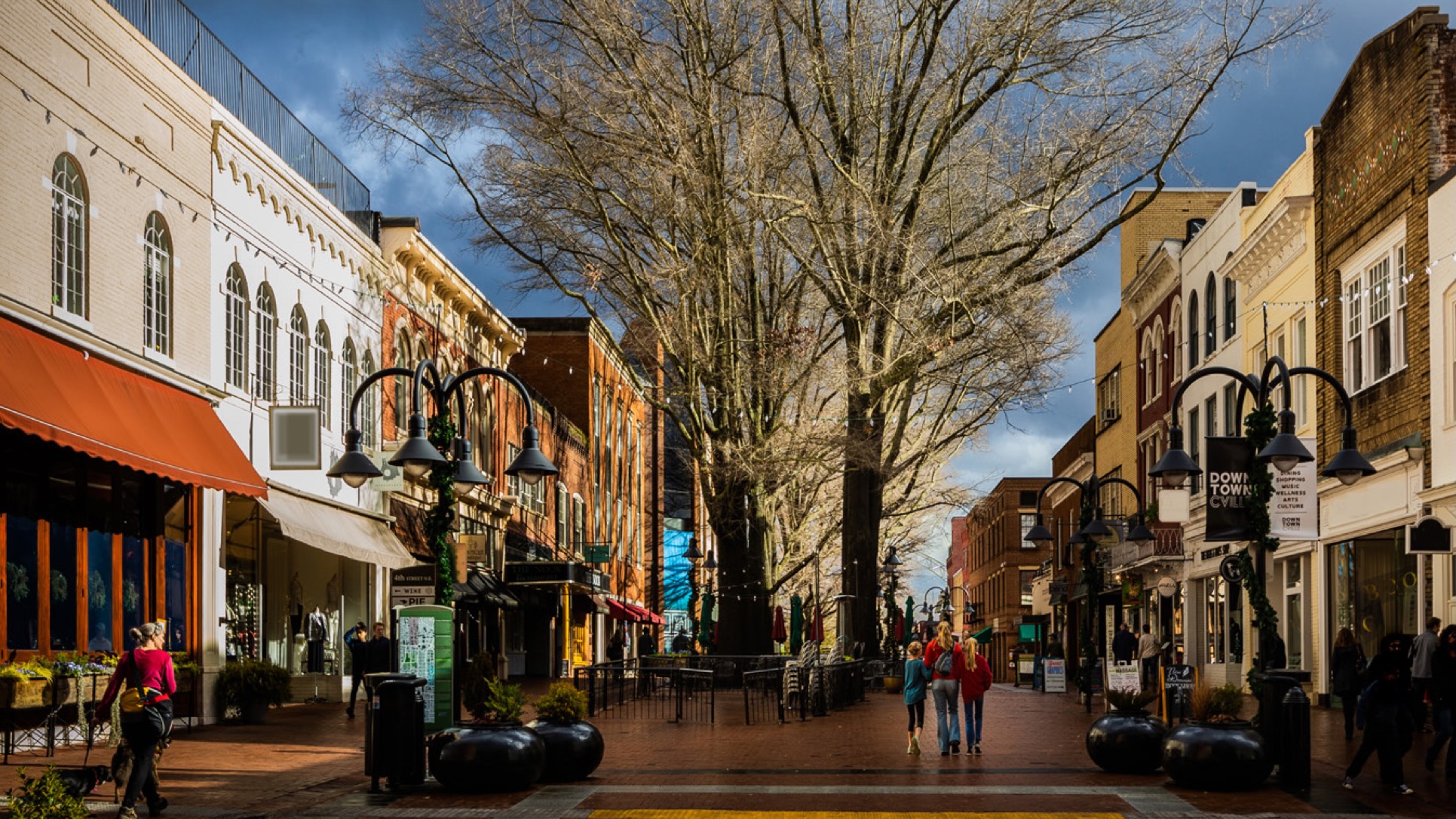
Home to a prestigious university and a growing, diverse population, Charlottesville VA (population: 46,553) has many things in common with Princeton. But although there is much to appreciate in its walkable downtown, Charlottesville has also struggled in recent years with a growing crisis of housing affordability. Increasing prices threaten long-standing communities who are at risk of displacement, and young people find it hard to find places to live. In response, the city is enacting far-reaching changes to land use, with a specific focus on racial equity and affordability. As Princeton works to rewrite its community master plan for the first time since the 1990s, could lessons be learned from a similar college town?
For many Charlottesville residents, the events of August 2017 brought long-standing racial inequities into sharp focus. A major rally by white supremacists on August 12, 2017 caused chaos and one counter-protestor was murdered. According to Matthew Gillikin of Livable Cville, a local advocacy group, “that weekend, many white Charlottesville residents, myself included, saw the realities of racism in ways they hadn’t previously experienced.”
At the same time, Charlottesville was gearing up for a reexamination of its Comprehensive Plan, the document that guides planning throughout the city. The city decided to also create a new affordable housing plan, and conduct an overhaul of zoning. As in Princeton, Charlottesville’s African-American population is under pressure, and less likely to benefit from the security and generational wealth that comes from home ownership. The new plan, with its focus on equity, would aim to lower the barriers to home-ownership, improve rental affordability, and bring in new measures to protect residents at risk of displacement.. It was developed through an intensive community outreach effort, including the excellent website, “Cvilleplanstogether.com“.
Charlottesville’s new Comprehensive Plan, which was ratified unanimously by the city council in 2021, features a “Future Land Use Map” that illustrates how the city will aim to enable and incentivize affordability:
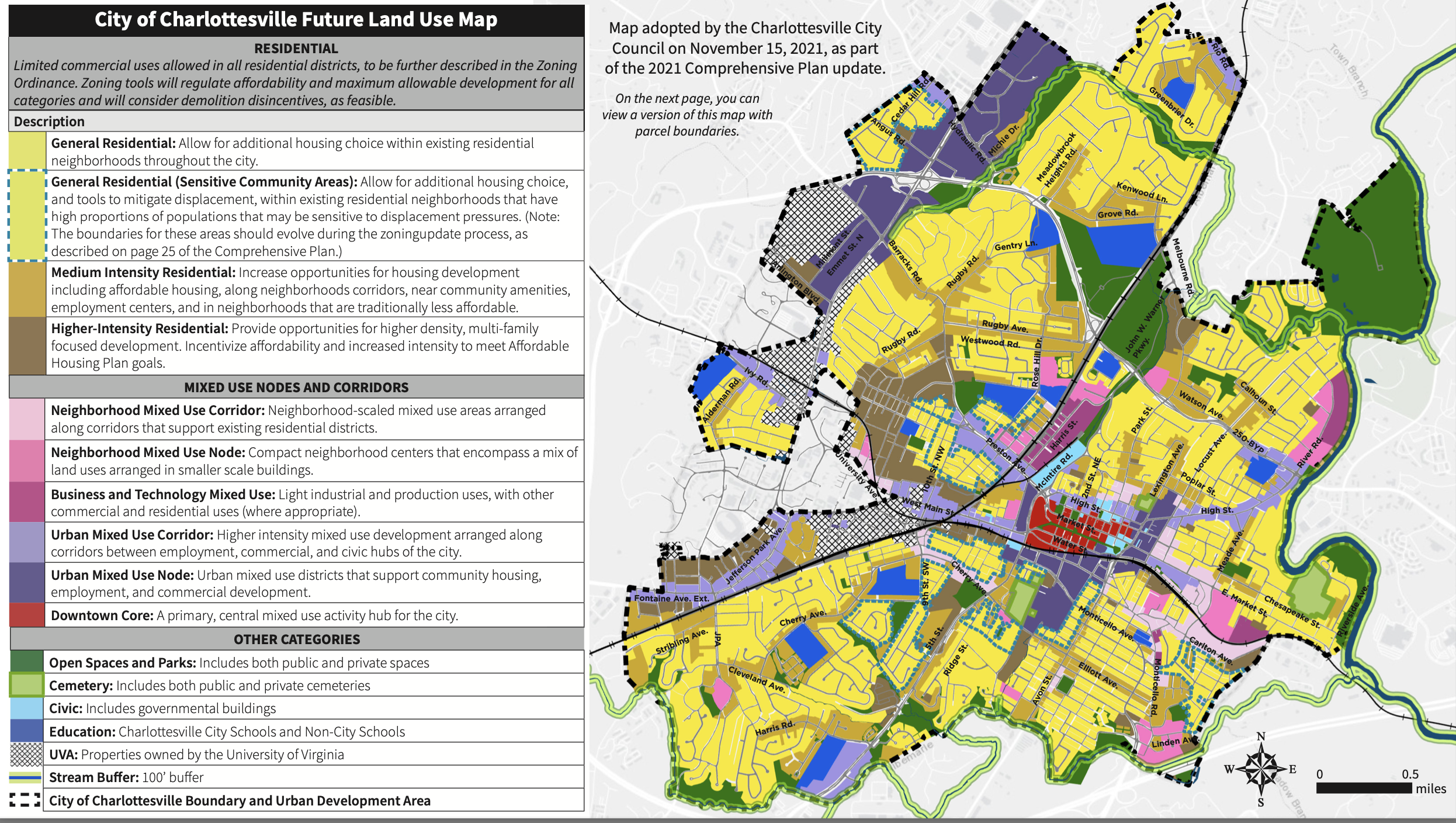
Whereas Princeton currently has 54 different zones, each with their own rules for development, the future land use map of Charlottesville would have about 10 zones. Most residential areas would fall into a new category: “General Residential”, which, significantly, would allow for up to four homes on each residential lot. Instead of building one large ‘McMansion’ on a single lot, several smaller homes could be built, which are likely to be more affordable. This change is happening throughout the city, but an additional rule applies in certain neighborhoods where there is considered to be a high risk of displacement. In these “sensitive communities”, lots could potentially still be converted to up to four homes, but one of the homes would have to be priced suitable for a low/moderate-income household.
Other smaller homes would be incentivized in “medium intensity residential” zones, which are spread among every neighborhood, and which would allow for small apartment buildings of 8-12 units and up to four stories. Higher density buildings would be limited to specific corridors, where up to five stories would be permitted, or in the downtown core, where up to ten stories would be permitted. The city is also studying its ability to introduce “inclusionary zoning” in downtown buildings, to the extent allowable by Virginia state law. (Princeton already has a 20% inclusionary zoning requirement on all buildings that benefit from zoning variances or other municipal incentives.)
The plan also prioritizes economic development, and parkland preservation. The exact details of the zoning for the future land use map are still under consideration, and several elements remain controversial. It seems likely that Charlottesville will successfully realize large parts of its new land use framework, however, which will ensure that the city continues to thrive and be a welcoming place that a wide variety of people can call home.
Related materials:
- Charlottesville Planning Website: Cvilleplanstogether.com
- Charlottesville Comprehensive Plan, 2021
- Charlottesville Affordable Housing Plan, 2021


Great article about quality of life efforts. I recently visited the Princeton campus and thought, can UVA learn anything? A shift to an all-electric bus fleet, an athletic campus powered by renewable energy, and a concerted effort to make the entire university more sustainable. Princeton has put these transitions front and center.
While there are many commendable efforts at UVA, it is disappointing that the administration and Board of Visitors continue to slow-walk efforts toward sustainability and renewable energy on the Grounds.