Voting ends today, Wednesday December 3, for the Princeton “People’s Choice” information kiosk design contest. As we reported earlier this year (“Students, Architects Encouraged To Submit Entries for Nassau Street Information Kiosk Design Contest“), the town has been holding a contest to design replacements for the information kiosks on Nassau Street. Six designs were selected for a public vote, which may or may not determine what kind of kiosk replaces the existing one outside the ‘Garden Theater’. The designs have been on display in the lobby of the Princeton Public Library for several weeks. Full details are also available at the municipal website at this link.
This has been a fun contest, and an interesting exercise in public engagement for planning. The designs got thorough discussion thanks to reporting in “Tap Into Princeton” (“Deadline Set for Voting in Kiosk Design Competition: Wednesday, December 3“) But the author of that report stayed neutral about what design was best. Clearly, opinions are going to differ about which design is best, and that’s why there’s a vote, but one option does seem better than the others.
Before getting to that option though, a quick word about ‘Option #2’, the “Gateway Kiosk”. Whoever produced this design ‘borrowed’ the ‘Walkable Princeton’ logo straight from our website. We are flattered by this homage, but we had absolutely nothing to do with the design. Although there are aspects of the “Gateway Kiosk” that are interesting, it falls into the trap of several of the design options of devising a whole placemaking experience instead of focusing on the core mission of providing an information stand.
Sidewalk space in downtown Princeton is often pretty limited. People walking often have to jig around streetlights, business signs, trashcans, outdoor dining, and new landscaping features intended to absorb stormwater. This is even more challenging for people in wheelchairs or with kids in strollers. Compactness is therefore a very significant virtue for any information kiosk. One of the problems with the existing information kiosks, which are much-loved by many local residents, is that they are very bulky. That is not such a big problem on Nassau Street outside the Gardent Theater, where there is a lot of sidewalk space, but the new information kiosks would ideally be used at other locations where space is at a premium.
Many of the features that the architects have put into their designs, like shelters, seats, bike racks, and book libraries, are beyond the scope of what an information stand is supposed to do. They are certainly of value, but a great information kiosk should be able to be placed anywhere in the town, with added features included only where it is appropriate.
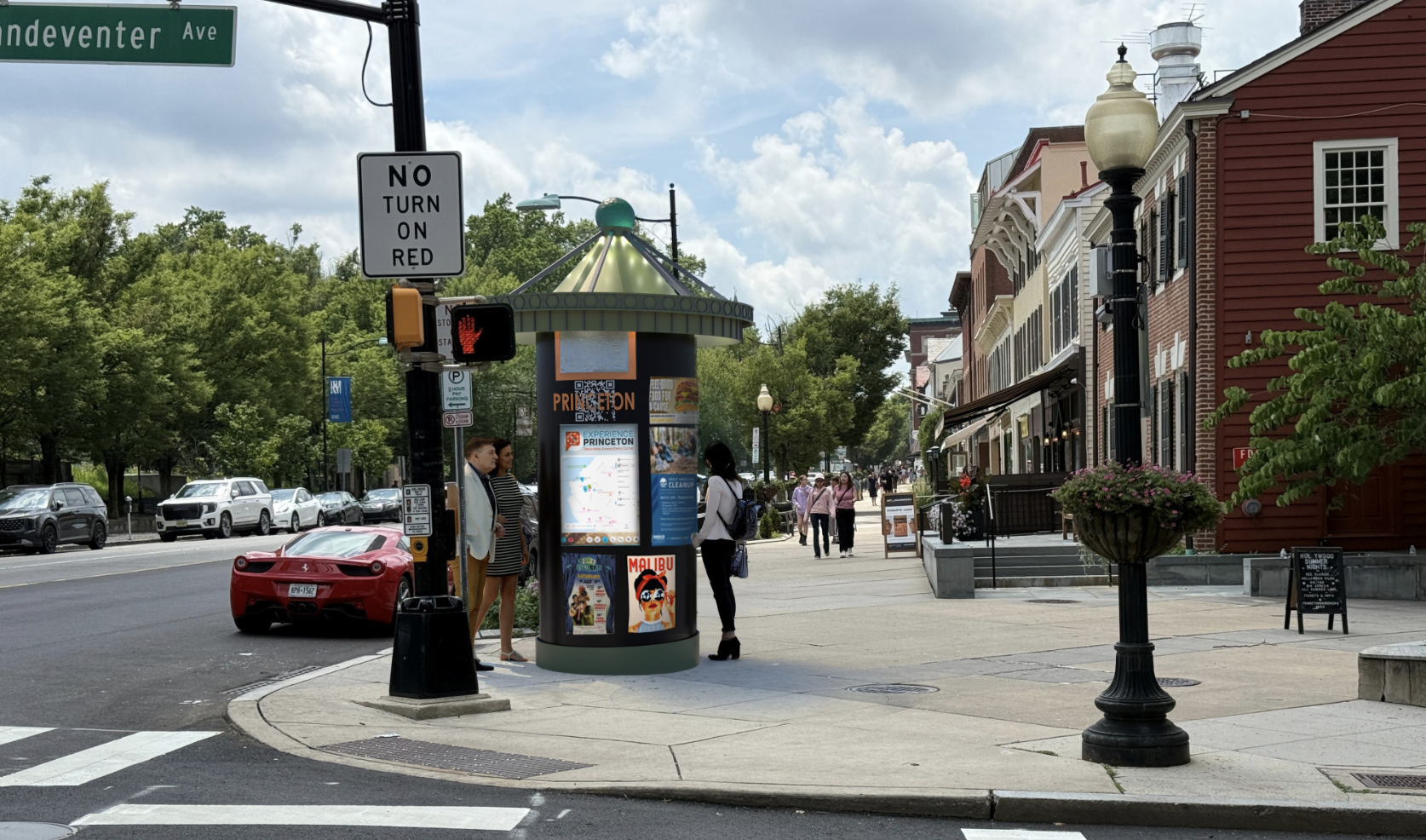
As such, Option #3 (shown at top) stands out as a really good design. The compact design lends itself to being used at multiple locations, allowing notices to be placed in a wider range of places around the town. It is a simple, elegant design, which does not obstruct foot traffic. Option #6 is another good choice, but with its solar panel and more modern design, it may get resistance from Princeton’s Historic Preservation Office. Much of downtown Princeton is a historic disrict, and a design for a new bus shelter on Nassau Street with an environmentally-friendly ‘green roof’ was rejected by preservationists, who didn’t think it matched the character of the neighborhood. Option #3, which is more similar to the existing kiosks, is less likely to encounter this kind of opposition.
Related materials:


 walkableprinceton