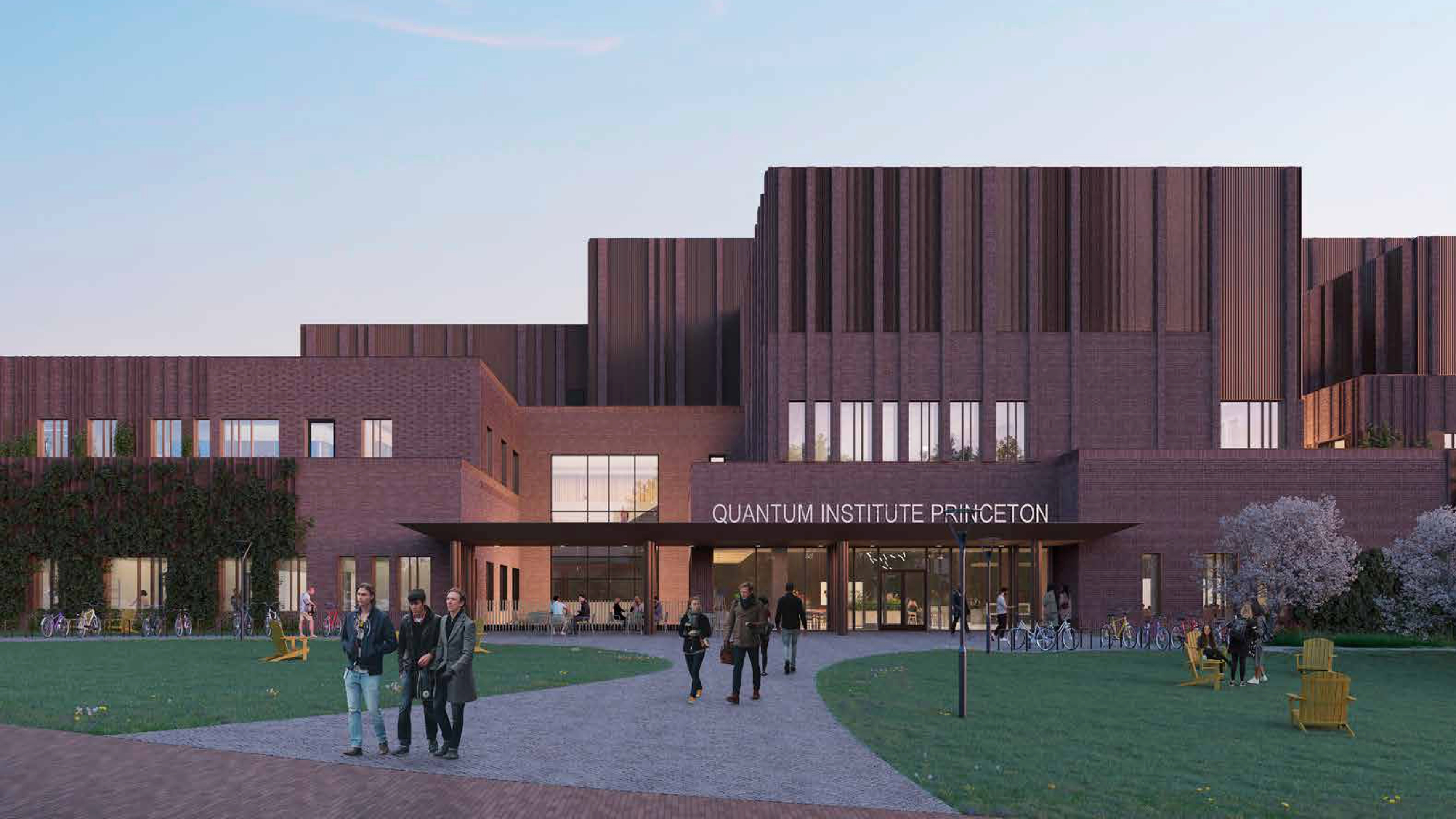
At a meeting on October 9, the Princeton Planning Board gave full approval to Princeton University’s proposed ‘Quantum Institute’. The 225,000 sq ft building will be built at Ivy Lane and Fitzrandolph Road, on the east side of the University campus (map). At present, the site is used as a University softball field, Strubing Field. The building will be used for high-tech research, fabrication, and teaching.
Princeton University presented a concept plan for the ‘Quantum Institute’ last year (Report: Princeton University Unveils Concept Plan for New ‘Quantum Institute’ on Ivy Lane). The plan presented on October 9 was quite different, however. Instead of filling the entire block from Fitzrandolph Road to Stadium Drive, as shown in the concept plan, the Quantum Institute will only occupy about half of the block. The remaining land will be banked as a ‘temporary meadow’, before being used for an academic building sometime in the future.
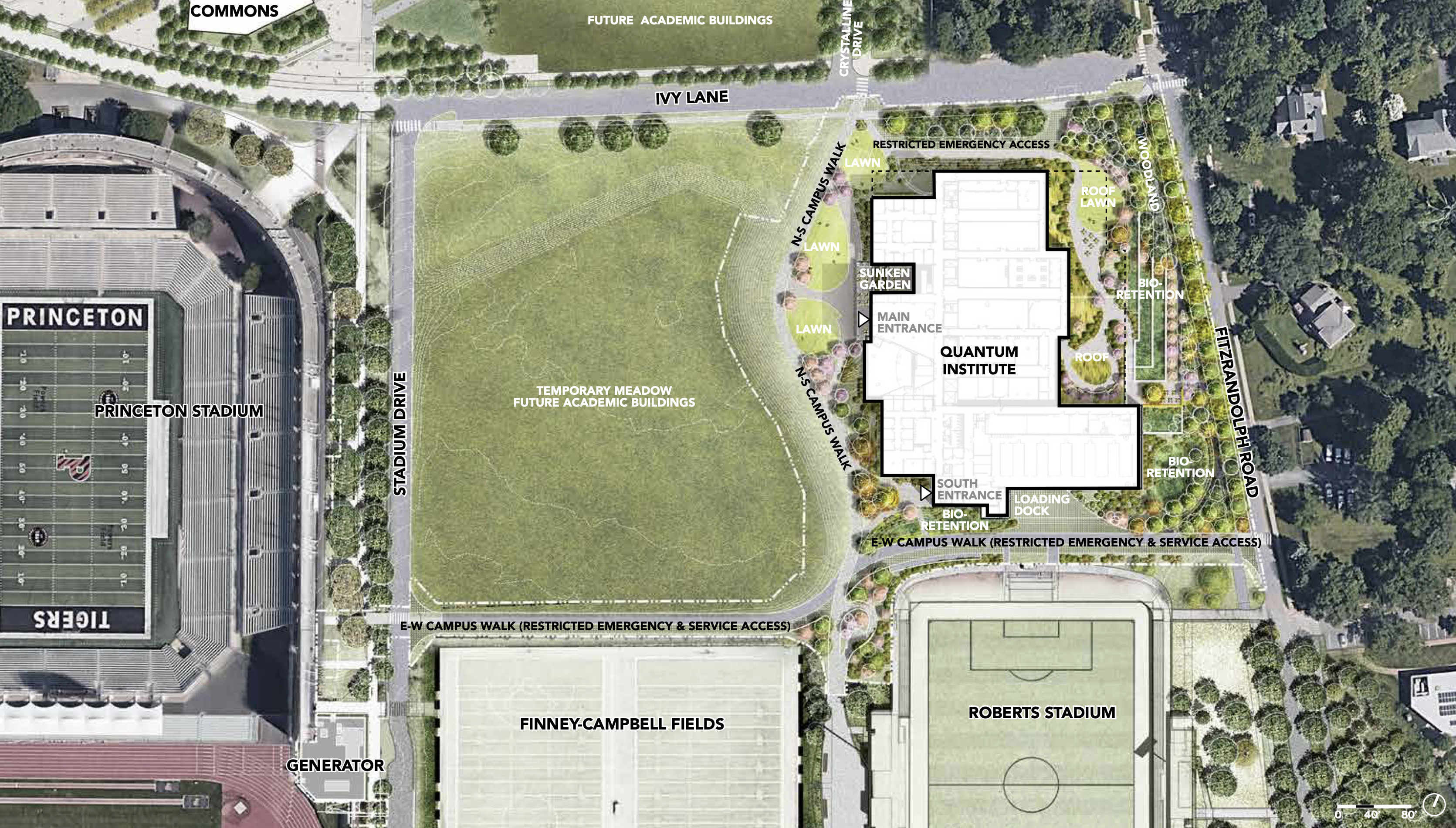
The slightly squat building has been designed to minimize its visibility from surrounding residential areas. Strategies for minimizing stormwater run-off were prioritized ahead of designing the building. The Planning Board’s stormwater consultant, Joe Skupian, noted that stormwater would be handled with 43 sub-surface porous-paved detention basins, at least four separate green roofs, and six bioretention basins. University architect Ron McCoy said that the stormwater plan was highly integrated, and likely to be a model for how the University would construct buildings in the future.
The University’s 91-slide presentation was warmly received by the Planning Board. Another recent University project on the east side of campus, the ‘TIGER Geo-Exchange‘, became the subject of a lengthy court battle waged by a local resident, Helen Nissenbaum. (The case was ultimately dismissed in 2023). In contrast, there were no objections to the Quantum Institute during public comment at the hearing on October 9.
Criticism of the plan were quite minor. The Board’s traffic engineer, Victor Anosike, had some concerns about traffic flow. There will be no car parking available at the Quantum Institute. Staff arriving by car will be required to park at the University’s vast Stadium Drive Garage, which can hold 1,560 cars. Mr Anosike was concerned that adding traffic to the roads approaching the parking garage could lead to congestion, but the University’s experts noted that a full traffic study had already been approved for the garage when it was approved. At present, the garage is only partially utilized, because it was built with the expectation that more University facilities like the Quantum Institute would be built over time.
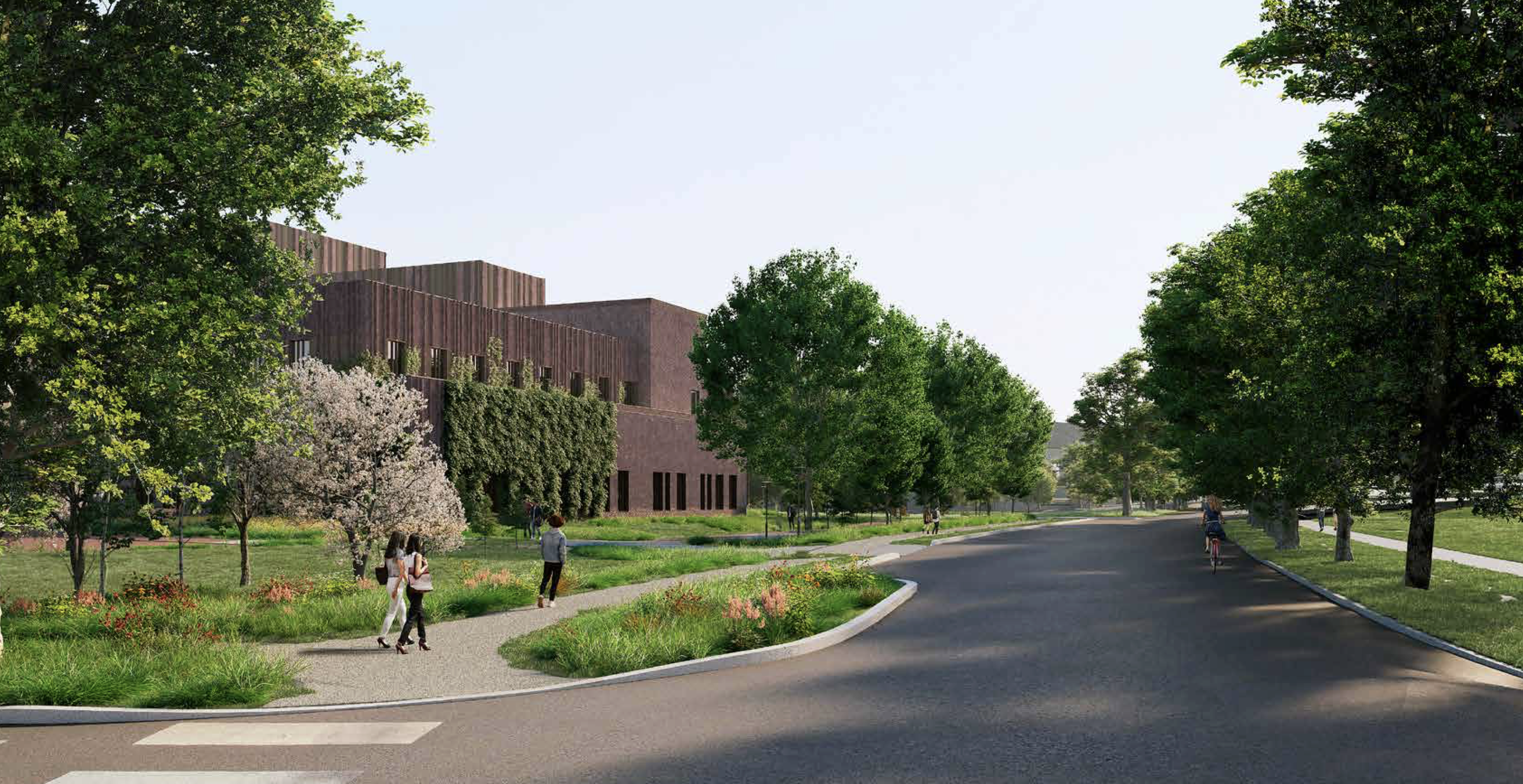
The Quantum Institute will be surrounded by extensive landscaping and ‘structured gardens’. Although most of the plantings will be of native species, a proposal to plant English ivy in the ‘sunken garden’ drew ire from Planning Board chair Louise Wilson. Although ivy is strongly associated with Princeton University, English ivy is an invasive species in New Jersey, and features on the FoHVOS “Do Not Plant” list. Ms Wilson described it as ‘a scourge’ and encouraged the University to consider other vines, such as Virginia creeper, instead.
Multiple walking paths will provide access to the Quantum Institute from other points on campus. The reconfigured Ivy Lane, on the north side of the development, will also be restriped as an ‘edge lane road‘. Edge lane roads have striped shoulders and a narrow lane for motor vehicles in the middle. Motor vehicles can pass in opposite directions by momentarily moving into the shoulders. Princeton University has previously used this approach on College Road, near the Graduate School. Edge lane roads are likely to appear in the town soon too. Earlier this month, Princeton Council passed a resolution to set up Armour Road with edge lanes.
The Quantum Institute proposal required three variances from the Planning Board for building signs and way finding signs. These variances were passed unanimously, along with the full proposal.
Related materials:


 walkableprinceton