
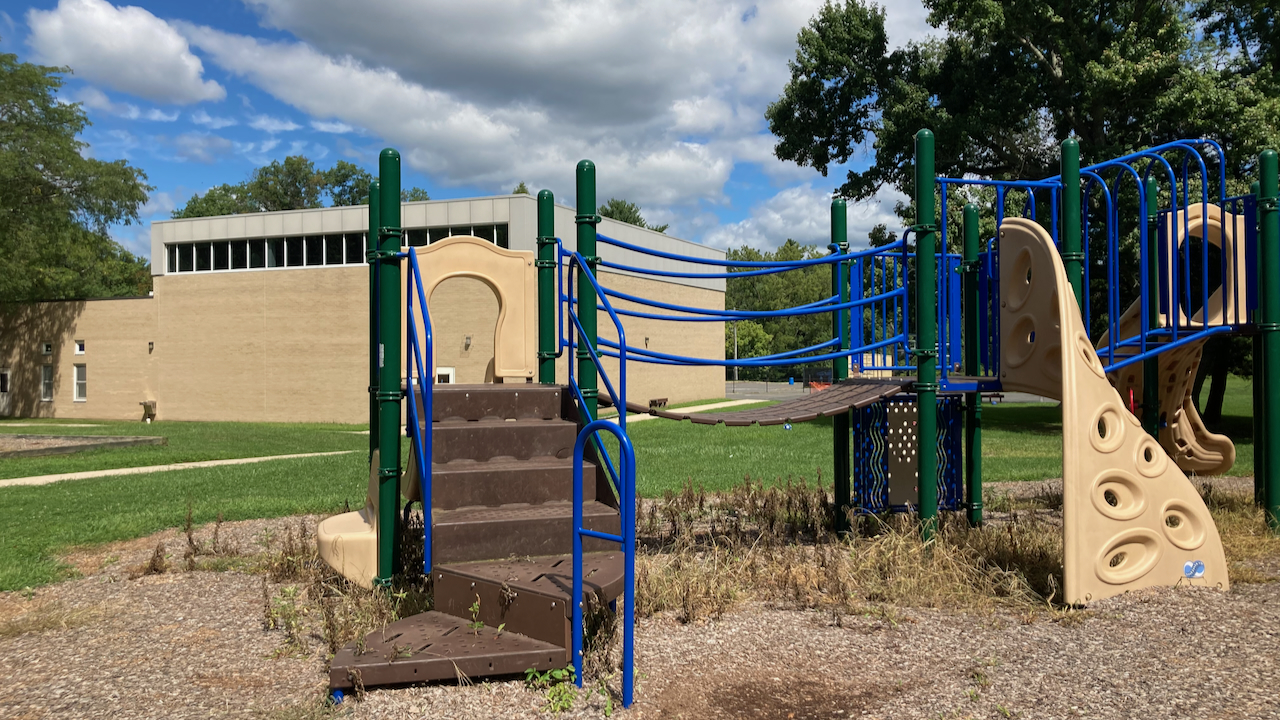
“I want to go to bed! I don’t want to be up at this time of night!” That was one of a number of complaints leveled at the Princeton Planning Board by members of the public during an occasionally-testy discussion about plans to expand Littlebrook Elementary School. The Planning Board is currently considering expansion plans at multiple local schools. Six new classrooms and a new music suite will be added at Littlebrook Elementary, based on capital plans approved by voters in a 2024 bond referendum (Report: “Princeton School Board Unveils New Renderings Of Local Schools After Bond-funded Improvements“). Concerns did not focus so much on the classrooms as on plans for parking and a retention basin that is intended to manage stormwater run-off.
The discussion about Littlebrook Elementary drew significantly more interest in public comment than the hearing about plans for Princeton Middle school. (Report: “Planning Board Questions Plans for Parking and Electric Vehicle Charging at Princeton Middle School“). One Littlebrook neighbor expressed concerns about an increased risk of flooding caused by the new construction. In response, consultants hired by the School Board said that the site reconstruction would reduce stormwater run-off, by adding a new bioretention basin at the rear of the school. The retention basin is a ‘green’ stormwater management facility, which is designed to capture rainfall in heavy storms, and then release it slowly to local waterways. The size of the retention basin would meet strict state regulations that require it to be big enough to deal with a “100-year storm”.
The retention basin was the subject of much criticism, however. One neighbor said that it was incongruous to put a retention basin next to the school nature trail, which is supposed to teach children about how to live in harmony with the environment. Another neighbor felt that the retention basin would reduce the space for kids to play, and suggested that it should be re-oriented with respect to the school. Somebody else feared that children might drown in rainwater collected in the pond.
The School Board’s professionals responded that the retention basin would be fenced off so that children could not enter. But how, then, would kids retrieve a ball that landed in there? Planning Board member Nat Bottigheimer noted that this was not a hypothetical question, because he himself had lost a soccer ball on the roof of Littlebrook Elementary School. A school board official said that only teachers or school staff would be permitted to enter the retention basin to retrieve lost balls.
Neighbors speaking in public comment also expressed irritation about people parking on local streets while visiting the school. They felt that the parking study that was carried out for the school redevelopment underestimated the amount of parking that is required. That does not mean, however, that they were happy about the School Board’s plans to extend the parking lot at Littlebrook Elementary.
“I don’t think we actually need more parking at the school, we need a better management system for why we have less people driving in the neighborhood, whether that’s staff, students, or anyone else,” said one neighbor. “We would not need that retention bay if we weren’t adding more parking spaces,” said another local resident. “Why aren’t we encouraging a more walkable Princeton? Why aren’t we providing more transportation so that all people in Princeton can transport to their schools without having to drive their cars?”
The School Board’s consultants said that the school district works with Sustainable Princeton to offer programs aimed at encouraging walking and cycling to school. They also hope that expanding Littlebrook Elementary will reduce the amount of out-of-zone schooling, which could increase the number of students who can walk or bike to their local school. Nevertheless, it does not seem that the current plans for Littlebrook Elementary will enhance the ability to arrive on foot or by bike, even though a larger parking lot for cars will be provided.
Excessive lighting and noise pollution also came up as issues that annoy local residents. One nearby resident said that the air-conditioning units at Littlebrook school were making the neighborhood like an industrial zone. The neighbor who was upset about staying up late to make a public comment compared the sound to “a small Cessna coming from the school.” She also believed that trees were the only proposed shielding between lighting at the school and nearby homes, and that this was completely inadequate. “Do you know what ‘deciduous’ means?” she asked. “It means that in the winter, all the leaves fall off…you need to go and walk the site, not sit in your little offices and draw your little drawings!!”
On these points, the neighbors got some clear action from the Planning Board. In approving the application for expansion of Littlebrook Elementary school, the Board set conditions requiring that lighting be properly shielded to minimize impact on neighbors, and for noise abatement to be installed on rooftop HVAC equipment. The retention basin is definitely going to be part of the final plan, however, as it is required by state law.
The Planning Board will next consider plans for expansion at Community Park Elementary School, at a meeting this Thursday, October 16.
Related materials: (via princetonnj.gov)
- Site plan drawings for expansion at Littlebrook Elementary School
- Architectural drawings for expansion at Littlebrook Elementary School
- Traffic Impact and Parking Assessment for Littlebrook Elementary School
- Planning Department summary of expansion proposals at Littlebrook Elementary School
- Video of the meeting. Discussion of Littlebrook School beings at 1:33:50


 walkableprinceton