
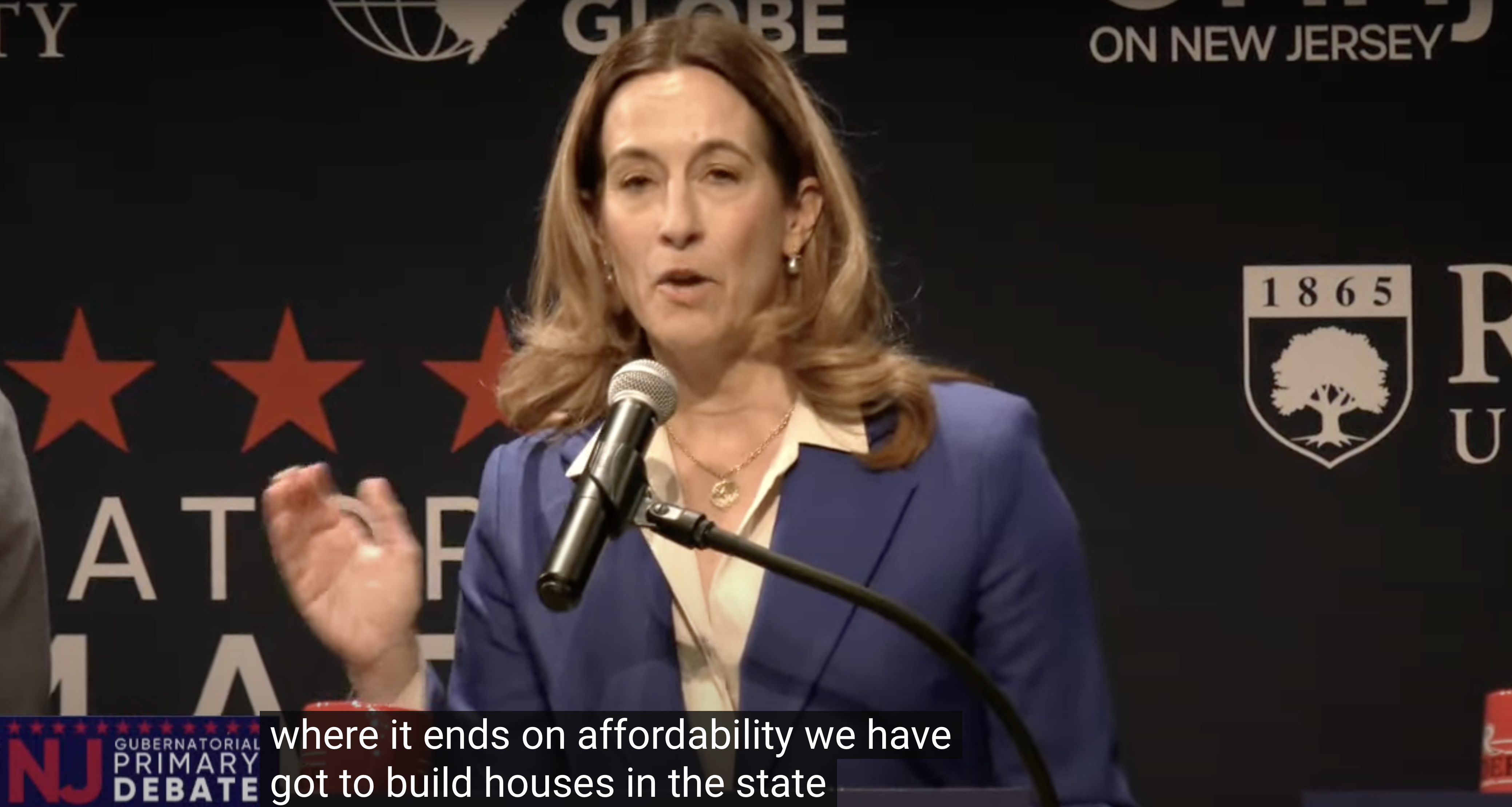
New Jersey will elect a new governor in November, and potential voters got a chance to get to know the candidates a little better on Sunday at the first Democratic Primary Debate. The debate, which happened at Rider University in Lawrenceville, featured candidates Steve Sweeney, Ras Baraka, Steve Fulop, Mikie Sherrill, and Josh Gottheimer. (See profiles of the candidates here, via northjersey.com: “Who is running for New Jersey governor in 2025?”) The debate covered a wide range of topics, but the issues of housing and transit generated significant discussion, with the candidates resolving to improve affordability and get NJ Transit working better. But when it came to actually providing concrete solutions, it wasn’t always clear that all of the candidates had realistic plans in mind.
Housing came up at the debate as part of a broader discussion about affordability in New Jersey. Candidates recognize that the cost-of-living is too high. Josh Gottheimer said, “we can make housing more affordable, we can build more housing and make sure we actually get more supply out there for workforce housing, for senior housing, to help families out.” But where and how would that housing get built? Gottheimer did not explain. Ras Baraka and Steve Fulop, the mayors of Newark and Jersey City, have a track record of building lots of housing, including affordable housing. They pointed to their records as evidence of what they could get done. Steve Fulop has also published a detailed housing plan.
Mikie Sherrill was emphatic about the need to build more housing. As she said, “We have got to build houses in this state. We are not going to make New Jersey more affordable if we don’t make housing more affordable.” Sherrill favors redeveloping existing commercial sites as housing. Princeton, notably, has had some success with this recently, such as the award-winning redevelopment of a vacant office park at Thanet Circle. Mikie Sherrill pointed to redevelopment in Harrison NJ as an example of a success story. Harrison added about 6,000 new residents in the 2010s, by building homes on formerly industrial sites. Sherrill mentioned “Trenton and Atlantic City” as other places where more housing could be built, although those may not be the places where the need for new housing is greatest.
When asked about NJ Transit, all of the candidates gave the current service an ‘F’ grade. Josh Gottheimer said he had personal experience of his family encountering train delays and cancelations. He pointed the finger of blame at Amtrak, which maintains the track that many NJ Transit trains use. Many recent service disruptions have been linked to problems with Amtrak’s overhead wires, which are very old and not the best design. As he put it, “We’re paying $200 million a year to Amtrak and they’re sticking it to our families…and they hold our trains up while they let their trains go by!”
Gottheimer was also furious with New York City officials who introduced a new $9 charge to drive into the city earlier this year. That congestion charge affects many residents in his district, and he raged, “We have to fight them! Keep fighting them!! And when I’m Governor, believe me, this will end!” Of course, even if Gottheimer was able to somehow end the New York congestion charge, it’s not clear how that would improve transit in New Jersey. Mikie Sherrill said that regular problems with NJ Transit caused her husband to give up on coaching youth soccer, because he was late home so often. She also blamed Amtrak. Having helped directed hundreds of millions of dollars of federal funding to rail projects in New Jersey, Sherrill said she was appalled that Amtrak could not keep the infrastructure in good condition.
Steve Fulop again pointed to his record as Mayor of Jersey City for proof of his commitment to sustainable transportation. During his mayorship, he had direct experience of operating ferries and launched a new on-demand transit system, which provides options to people in areas of the city where NJ Transit routes are limited. Jersey City also now has the largest bike-share system in the state. Fulop said that the next governor should cancel the proposed $11 billion widening of the NJ Turnpike through Bayonne and Jersey City, and reallocate that money for mass transit.
Fulop was among the first to propose a new corporation tax to provide a dedicated funding source for NJ Transit. That was enacted last year, but Fulop was frustrated that statehouse Democrats set a 5-year time limit on the program. He wants to extend that funding source, to ensure that NJ Transit has stable, long-term funding, which could be used to raise bonds for capital improvements. Fulop also said that he was frustrated with private bus carriers. He observed that many private bus routes operated more efficiently when they were taken over by NJ Transit, and hoped that more services could be “taken back in-house”.
Steve Sweeney said that he had been advocating for stable funding for NJ Transit since 2018, when he was state Senate President. He described NJ Transit as “an embarrassment and an insult to the citizens of this state.” Sweeney spoke of the need for “good leadership” at NJ Transit, and welcomed the recent appointment of Kris Kolluri as the head of the agency. Kolluri only took the job until the next governor comes in, however, so there is presumably going to be an important vacancy to fill by whoever the next governor is.
The candidates will have another chance to lay out their vision for New Jersey at a forum being held by the Princeton Community Democratic Organization this coming Sunday, February 16. The event, with all six candidates, will take place at the Suzanne Paterson Center, 45 Stockton Street, Princeton (map) at 7 p.m. Pre-registration is advised (click here for link to register). The event will also be live-streamed on the PCDO Facebook page at https://www.facebook.com/PrincetonDemocrats/.
Related content:
- Video of the first NJ Democratic Gubernatorial Primary Debate on 02/02/2025:


 walkableprinceton