Josh Wilton is one of Princeton’s most successful realtors, a co-owner of ‘Queenston Realty‘ who is also known for his regular podcast, “The Wilton Report“, in which he analyzes the market for property sales and rentals. The show is always packed full of data, and in the latest episode, Wilton shared some eye-popping details about the market for homes in Princeton. In brief, homes in Princeton are increasingly out-of-reach for all but the wealthiest buyers – and Wilton thinks that the town’s historic preservation efforts are contributing to problems with affordability.
Wilton has been tracking the availability and sales prices of homes in Princeton for years. He uses this information to advise his clients, and help them find a home or sell their own home for the best price. In recent months, he has noted how ‘inventory’, i.e. the total number of homes for sale in Princeton, has been at historic lows. This has sent home prices sky-high, and has made it extremely difficult for families trying to get a foothold in the property market.
As Wilton discussed in his latest episode, 50% of homes in Princeton are now for sale at $2 million or more. That makes the median home in Princeton a $2 million home. Homes that quite recently would have cost $800,000 now sell for $1.3 million. Homes that used to cost $1.6 million now sell for over $2 million. These high prices make it incredibly difficult for middle-class people to live in Princeton. The problem is not unique to Princeton. Data shared by Wilton shows that throughout New Jersey, inventory is still 61% lower than before the pandemic. Inventory in other states, notably in the Sun Belt, has recovered, and is now even higher than before the pandemic, helping to limit price increases there.
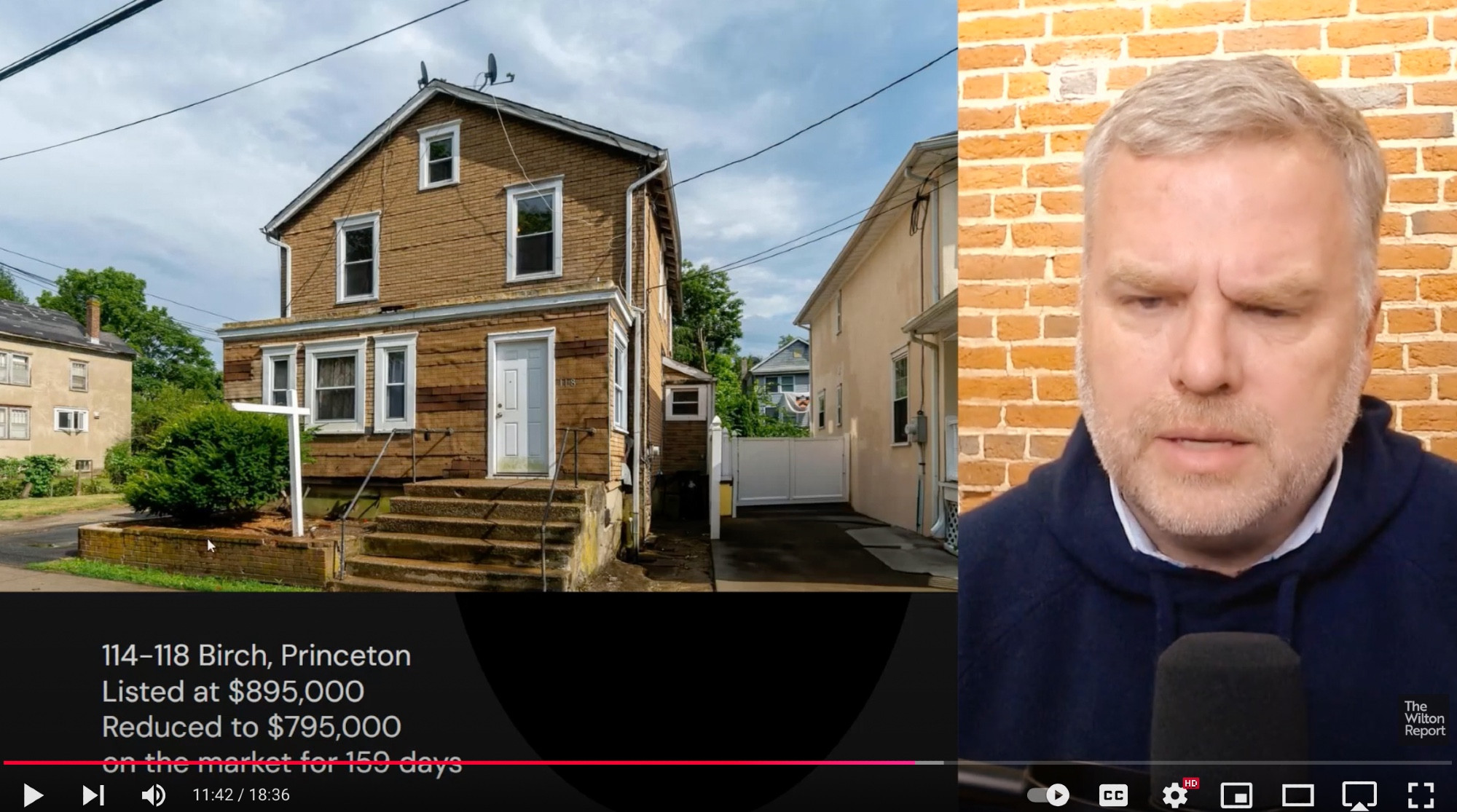
So why does Princeton build so few houses that people can buy to live in? Wilton says that historic preservation efforts are one major problem. He discussed an example of a property on Birch Avenue, which is in the Witherspoon-Jackson historic district. The property has an open lot next to it where a second home could be built. Ordinarily, this might be expected to be a valuable feature, but despite the shortage of homes in Princeton, the property went unsold for months. Wilton believes it is because his clients do not want to deal with the challenges of getting approvals from the Historic Preservation Office, and that strict historic preservation rules reduce the value of homes in historic districts.
Wilton further noted that since 2020, no new homes have been sold in the Witherspoon-Jackson neighborhood, although a few homes have been built and sold in other areas of town. He described this effect as being equivalent to ‘redlining‘, the historic practice of limiting investment in urban neighborhoods. Although Wilton did not discuss it in his podcast, redlining often affected neighborhoods with large numbers of African-American residents, and is now widely considered to be racist.
Princeton now has twenty-one local historic districts, which means that many building applications come under review by the Historic Preservation Commission. In recent months, questions about historic preservation have been used to undermine attempts to build mixed-income apartment projects in the Jugtown neighborhood and in the Mercer Hill neighborhood. The Historic Preservation Commission voted in June to recommend that a development with three affordable homes at 344 Nassau Street should be rejected. The application was subsequently withdrawn.
The case of the Witherspoon-Jackson Historic District is not an obvious case of racist redlining, however, because many African-American residents who lived in the area for a long time were strongly supportive of historic designation. In some case, they saw historic designation as a way to limit new development, and funnel new constuction to other neighborhoods. We reached out to Wilton for his thoughts about that. He said that he had clients who were African-American, who were shocked at how historic designation has affected the value of their property and their ability to make changes to it. He also noted that many of the homes in the district are not particularly historic, but are just old. Many of them need renovation and modernization, and this is harder to do with historic preservation rules.
We also reached out to Elizabeth Kim, the Historic Preservation Officer, for comments on this article, but received no response at the time of publication.
How has historic preservation affected you for better or worse? Let us know in the comments or email anonymously to walkableprinceton2@gmail.com
Related links:


 walkableprinceton